AI Agents Explained: What They Are and How They Work in 2026
AI agents have moved from research labs into everyday tools. Here is a clear explanation of what AI agents actually are and how they work in 2026.
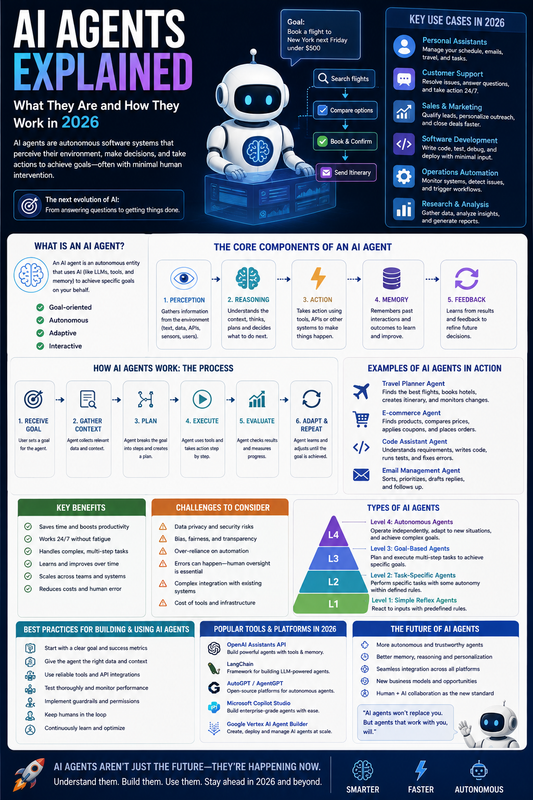
AI
Agents Explained: What They Are and How They Work in 2026
AI agents have become one of the most
talked-about developments in artificial intelligence, moving beyond simple
question-and-answer chatbots into systems capable of completing multi-step
tasks with a degree of autonomy.
How
AI Agents Differ From Traditional Chatbots
A traditional chatbot typically responds
to a single query with a single response. An AI agent, by contrast, can break a
broader goal into smaller steps, use external tools like web browsers or
software applications, and work through a sequence of actions to complete a
task with limited human intervention along the way.
Core
Capabilities of Modern AI Agents
·
Breaking down complex requests
into a logical sequence of smaller tasks
·
Using external tools, such as
web search, code execution or specific software integrations
·
Retaining context across
multiple steps of a task rather than treating each step in isolation
·
Adjusting their approach based
on results from earlier steps, rather than following a rigid, predetermined
script
Real-World
Applications of AI Agents in 2026
·
Automating repetitive business
workflows, such as scheduling, data entry or basic customer support
·
Assisting developers by
writing, testing and debugging code across multiple steps
·
Conducting multi-step research
tasks, gathering and synthesizing information from multiple sources
·
Managing personal productivity
tasks, such as organizing schedules or drafting and sending routine
communications
Why
AI Agents Represent a Meaningful Shift
Unlike earlier AI tools that required a
human to manage every individual step, AI agents can handle a broader objective
with less constant supervision, which has significant implications for how
businesses think about automating knowledge work, not just repetitive manual
tasks.
Current
Limitations of AI Agents
Despite genuine progress, AI agents in
2026 still face real limitations, including occasional errors that compound
across multi-step tasks, challenges with highly ambiguous instructions, and the
continued need for human oversight on tasks with significant consequences or
sensitive data involved.
What
This Means for Students and Professionals
Understanding how to effectively work
with AI agents, including how to give clear instructions and verify their
output, is becoming an increasingly valuable skill across many fields, similar
to how basic computer literacy became essential in previous decades.
Final
Verdict