AI Chatbots for Business: A Complete 2026 Guide
Thinking about adding an AI chatbot to your business? Here is a complete guide covering use cases, benefits and implementation tips for 2026.
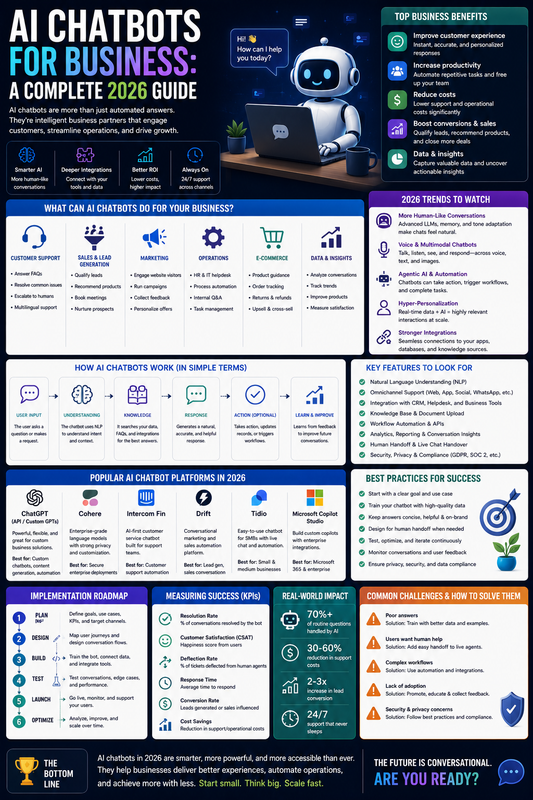
AI
Chatbots for Business: A Complete 2026 Guide
AI chatbots have evolved significantly
from simple rule-based systems into sophisticated tools capable of handling
nuanced customer conversations, making them an increasingly practical option
for businesses of nearly every size in 2026.
How
Modern AI Chatbots Differ From Older Versions
Older chatbots relied on rigid,
predefined decision trees that often frustrated users with limited, scripted
responses. Modern AI-powered chatbots can understand natural language more
flexibly, handle a wider range of questions, and maintain more coherent,
helpful conversations without needing every possible question mapped out in
advance.
Common
Business Use Cases for AI Chatbots
·
Handling frequently asked customer
support questions, freeing up human support staff for more complex issues
·
Assisting with product
recommendations and guiding customers through purchase decisions
·
Qualifying sales leads by
gathering initial information before handing off to a human sales
representative
·
Providing basic account support
and order status updates around the clock
·
Collecting customer feedback
and conducting simple surveys
Benefits
of Implementing an AI Chatbot
·
Providing round-the-clock
customer support without requiring 24/7 human staffing
·
Reducing response times for
common, repetitive customer questions
·
Allowing human support staff to
focus on more complex, higher-value customer interactions
·
Scaling customer support
capacity without proportionally increasing staffing costs
Key
Considerations Before Implementation
·
Clearly define which tasks the
chatbot should handle versus when it should escalate to a human representative
·
Ensure the chatbot has access
to accurate, up-to-date information about your products or services
·
Plan for a smooth handoff
process when a customer needs human assistance
·
Regularly review chatbot
conversations to identify gaps or areas needing improvement
Common
Mistakes Businesses Make
·
Deploying a chatbot without
adequately training it on business-specific information
·
Failing to provide a clear,
easy path to human support when needed
·
Over-relying on chatbots for
complex or sensitive customer issues that genuinely require human judgment
·
Not regularly reviewing and
updating chatbot performance based on real customer interactions
Measuring
Chatbot Success
Businesses should track metrics like
resolution rate, customer satisfaction scores for chatbot interactions, and how
effectively the chatbot reduces overall support ticket volume, rather than
judging success purely on the number of conversations handled.
Final
Verdict