AI Detection Tools: How They Work and Their Real Limitations in 2026
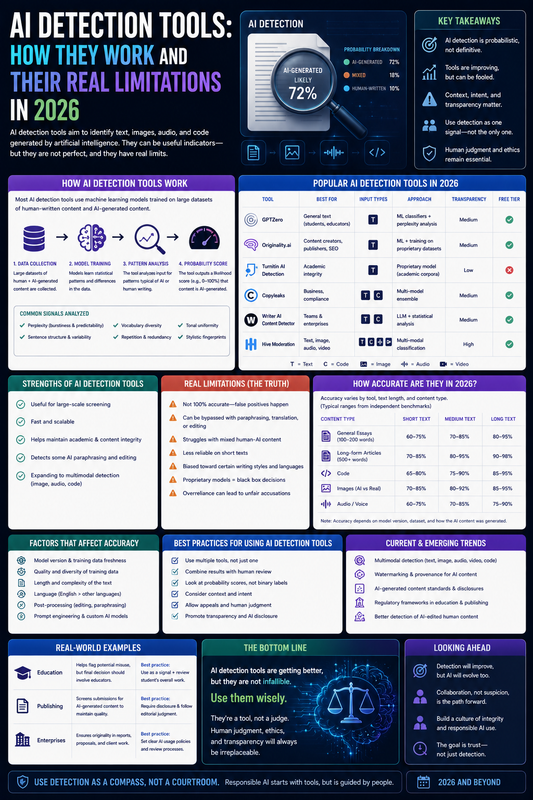
AI detection tools claim to identify AI-generated content, but how reliable are they really? Here is an honest look at how they work in 2026.
AI
Detection Tools: How They Work and Their Real Limitations in 2026
As AI-generated content has become more
common, tools designed to detect whether text, images or video were created by
AI have grown in popularity, particularly in education and content verification
contexts. However, understanding their real limitations is important before
relying on them heavily.
How
AI Text Detection Tools Generally Work
Most AI text detectors analyze
statistical patterns in writing, such as sentence structure predictability,
word choice patterns and consistency, that tend to differ between typical human
writing and AI-generated text, then estimate a probability score of AI
involvement rather than providing a definitive yes-or-no answer.
Why
AI Detection Tools Are Not Fully Reliable
·
They often produce false
positives, incorrectly flagging genuine human writing as AI-generated,
particularly for non-native English writers or very structured writing styles
·
They can produce false
negatives, failing to detect AI-generated text that has been lightly edited or
rephrased by a human afterward
·
As AI writing models continue
improving, detection accuracy has generally struggled to keep pace consistently
·
Different detection tools often
produce inconsistent results for the same piece of content
How
AI Image and Video Detection Tools Work
Image and video detection tools typically
look for subtle artifacts, inconsistencies or patterns characteristic of AI
generation processes, though as generation quality improves, these telltale
signs have become progressively harder to reliably detect.
Where
These Tools Are Being Used
·
Educational institutions
attempting to verify whether student submissions were AI-generated
·
Content platforms and
publishers trying to verify authenticity of submitted content
·
Journalists and fact-checkers
attempting to verify the authenticity of images or video circulating online
·
Businesses verifying the
authenticity of user-generated content or reviews
Practical
Implications of Their Limitations
Given their real accuracy limitations,
relying solely on AI detection tools for high-stakes decisions, such as
academic integrity cases, carries genuine risk of both falsely accusing
legitimate human work and failing to catch actual AI-generated content, making
them best used as one signal among several rather than definitive proof.
A
More Balanced Approach to Verification
Rather than relying entirely on automated
detection tools, many educators and organizations are shifting toward broader
strategies, such as designing assessments that are harder to complete purely
through AI, combined with direct conversations and process-based evaluation, to
more reliably assess genuine understanding and effort.
Final
Verdict