AI in Healthcare: Real-World Applications in 2026
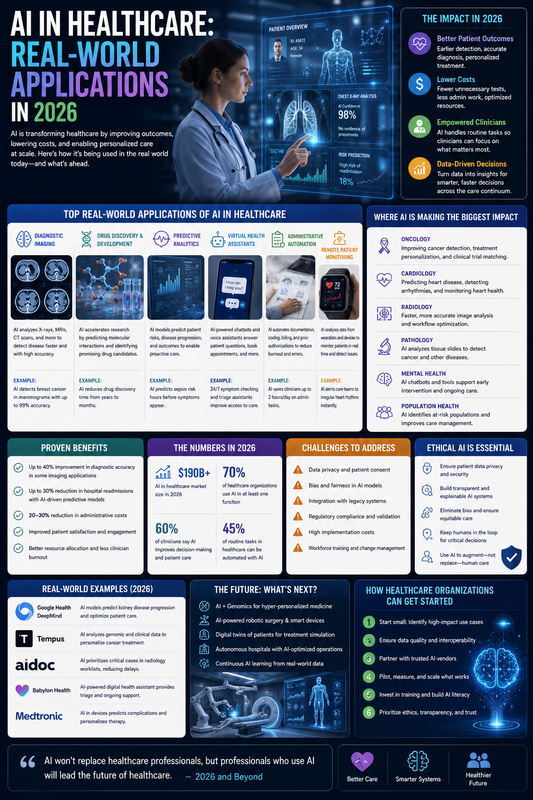
AI is being used across many areas of healthcare today. Here is an overview of real-world AI applications in medicine and healthcare in 2026.
AI
in Healthcare: Real-World Applications in 2026
Artificial intelligence has moved well
beyond experimental research in healthcare, with genuine, practical
applications now supporting diagnostics, treatment planning, drug discovery and
administrative efficiency across many healthcare systems in 2026.
AI
in Medical Diagnostics
AI systems are increasingly used to assist
doctors in analyzing medical images, such as X-rays, MRIs and pathology slides,
helping identify patterns that may be difficult to detect through manual review
alone, particularly for early-stage disease detection where subtle patterns
matter significantly.
AI-Assisted
Drug Discovery
Pharmaceutical research has benefited
significantly from AI's ability to analyze massive datasets and predict how
different molecular compounds might behave, helping researchers narrow down
promising drug candidates faster than traditional trial-and-error approaches
alone.
Administrative
and Operational Applications
·
Automating routine
administrative tasks like appointment scheduling and basic patient
communication
·
Assisting with medical
documentation and clinical note summarization, reducing administrative burden
on healthcare providers
·
Supporting hospital resource
management and patient flow optimization
·
Streamlining insurance claims
processing and reducing administrative errors
AI
in Personalized Treatment Planning
AI tools are increasingly used to help
analyze patient-specific data alongside broader medical research, supporting
more personalized treatment recommendations based on a patient's specific
health profile rather than purely generalized treatment guidelines.
Remote
Monitoring and Preventive Care
AI-powered wearable devices and remote
monitoring tools can track health metrics continuously, flagging potential
concerns early and supporting more proactive, preventive healthcare rather than
relying solely on periodic in-person checkups.
Important
Limitations and Considerations
Despite genuine progress, AI in
healthcare still requires careful human oversight, particularly for final
diagnostic and treatment decisions, since AI systems can make errors and lack
the full contextual understanding that experienced healthcare professionals
bring to complex cases. Data privacy and security also remain critical
considerations given the sensitivity of health information involved.
Why
This Area Interests Engineering Students
Students interested in the intersection
of technology and healthcare can explore projects involving medical image
analysis, health data platforms or diagnostic support tools, combining
technical skills with genuinely meaningful real-world impact.
Final
Verdict
AI in healthcare in 2026 continues to
demonstrate genuine, practical value across diagnostics, research and
administrative efficiency, while human oversight remains essential for final
clinical decisions. This balance of AI-assisted efficiency with human judgment
is likely to remain the standard approach for the foreseeable future.