AI and Job Automation: Which Roles Are Actually at Risk in 2026
How worried should you actually be about AI replacing jobs? Here is a realistic, balanced look at which roles face genuine automation risk in 2026.
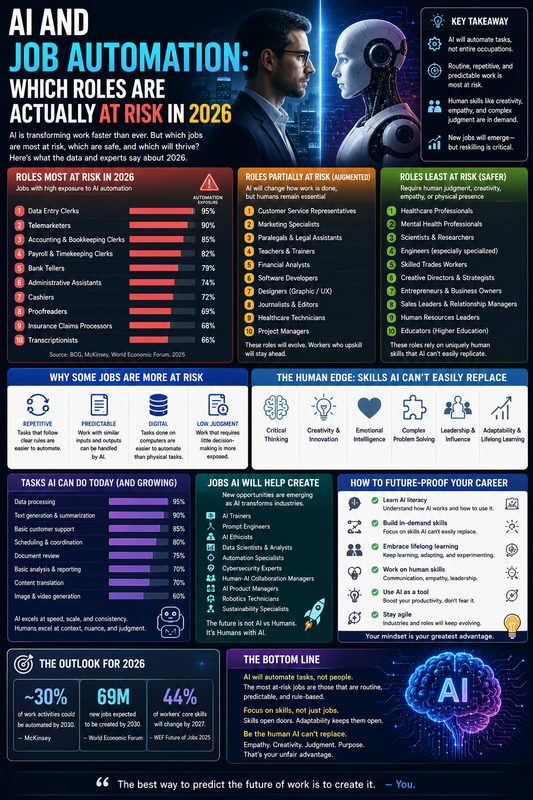
AI
and Job Automation: Which Roles Are Actually at Risk in 2026
Concerns about AI replacing jobs remain
widespread in 2026, but the reality is more nuanced than blanket predictions
suggest, with automation risk varying significantly based on the specific
nature of different roles and tasks rather than entire job categories
disappearing overnight.
Understanding
Task Automation vs. Job Elimination
Most current AI automation affects
specific tasks within a job rather than eliminating entire roles outright. A
role composed largely of repetitive, predictable tasks faces higher automation
pressure, while roles requiring complex judgment, creativity, interpersonal
skills or physical dexterity remain significantly more resistant to full
automation.
Roles
Facing Higher Automation Pressure
·
Data entry and basic
administrative tasks involving repetitive, rule-based processes
·
Certain aspects of customer
support, particularly handling routine, frequently asked questions
·
Basic content writing and
summarization tasks that follow predictable formats
·
Some aspects of data analysis
and reporting that follow consistent, repeatable patterns
·
Routine coding tasks, such as
generating boilerplate code or simple debugging
Roles
That Remain More Resilient
·
Roles requiring complex human
judgment, negotiation or emotional intelligence
·
Creative roles requiring
original strategic thinking rather than pattern-based output
·
Skilled trades and roles
requiring physical dexterity in unpredictable environments
·
Leadership and management roles
centered on people management and complex decision-making
·
Roles requiring deep domain
expertise combined with nuanced client or stakeholder relationships
How
AI Is Changing Roles Rather Than Eliminating Them
In many cases, AI is transforming how a
job is performed rather than eliminating it entirely. Professionals who learn
to effectively use AI tools within their existing role, such as using AI to
speed up research or drafting, often become significantly more productive
rather than being replaced outright.
How
to Future-Proof Your Career
·
Develop strong skills in areas
where human judgment, creativity and interpersonal skills remain essential
·
Learn to use AI tools
effectively as a productivity multiplier within your field, rather than
avoiding them
·
Focus on building deep,
specialized expertise that is difficult to fully replicate through automation
·
Stay adaptable and continuously
develop new skills as your industry evolves alongside AI capabilities
A
Balanced Perspective on AI and Employment
While certain tasks and roles genuinely
face automation pressure, historical technology shifts have generally also
created new categories of jobs alongside those displaced, though this
transition is rarely smooth or without genuine disruption for affected workers
in the short term.
Final
Verdict
AI's impact on employment in 2026 is real
but uneven, affecting specific tasks more than entire professions in most
cases. Building adaptable skills and learning to work effectively alongside AI
tools remains one of the most practical ways to navigate this ongoing shift.