Breast cancer detection using deep learning and gen ai for medical explanation
A deep learning-based breast cancer detection system integrated with Generative AI to classify medical images and provide clear, patient-friendly explanations that improve understanding while assisting healthcare professionals.
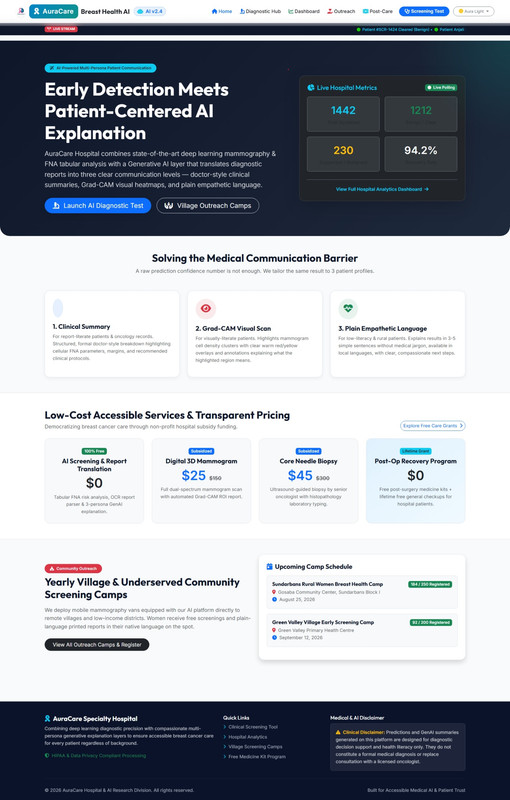
Breast Cancer Detection Using Deep Learning and Gen AI for Medical Explanation
Introduction
Breast cancer is one of the most common cancers affecting women worldwide. Early diagnosis significantly improves treatment outcomes and survival rates. Medical imaging techniques such as mammograms, ultrasound, and histopathology images play a vital role in identifying cancer at an early stage. However, interpreting these images requires experienced radiologists, and the increasing number of cases can create challenges in timely diagnosis.
Deep learning has demonstrated remarkable performance in medical image analysis by automatically identifying complex patterns associated with breast cancer. When combined with Generative AI, these systems can not only classify medical images but also generate clear, easy-to-understand explanations of the prediction, making healthcare information more accessible to both patients and medical professionals.
This mini project presents an intelligent breast cancer detection system that integrates deep learning for diagnosis and Generative AI for producing understandable medical explanations.
Problem Statement
Accurate interpretation of breast cancer images requires specialized medical expertise, and patients often find diagnostic reports difficult to understand. Existing AI models primarily focus on prediction without explaining their decisions in a human-friendly manner.
The proposed system aims to detect breast cancer using deep learning while generating simple, informative explanations that improve transparency and support clinical decision-making.
Objectives
The objectives of this project include:
- Detect breast cancer from medical images using deep learning.
- Classify images as benign or malignant.
- Generate patient-friendly medical explanations using Generative AI.
- Assist healthcare professionals with AI-supported diagnosis.
- Improve interpretability and trust in AI-based healthcare systems.
How the System Works
The proposed system follows these steps:
- Medical images are uploaded to the application.
- Images undergo preprocessing and normalization.
- A Convolutional Neural Network (CNN) extracts important features.
- The trained model predicts whether the tumor is benign or malignant.
- Prediction results are sent to a Generative AI module.
- The Generative AI generates a simplified medical explanation based on the prediction.
- The final report is displayed to the healthcare professional or patient.
System Architecture
The system consists of the following modules:
Image Upload Module
- Accepts mammogram or histopathology images.
- Performs validation and preprocessing.
Deep Learning Module
- Extracts image features.
- Performs classification.
- Predicts cancer type.
Generative AI Module
- Converts prediction into understandable language.
- Explains confidence and possible medical interpretation.
- Generates patient-friendly reports.
Database Module
- Stores patient records.
- Maintains prediction history.
- Stores generated explanations.
Admin Module
- Manages datasets.
- Monitors model performance.
- Controls system users.
Technologies Used
| Technology | Purpose |
|---|---|
| Python | Programming Language |
| TensorFlow / PyTorch | Deep Learning Framework |
| CNN (Convolutional Neural Network) | Image Classification |
| OpenCV | Image Processing |
| NumPy | Numerical Computing |
| Flask / FastAPI | Backend API |
| React.js | Frontend Development |
| PostgreSQL / MongoDB | Database |
| Generative AI Model | Medical Explanation Generation |
| HTML, CSS, JavaScript | User Interface |
Features
- Breast cancer image classification
- Deep learning-based prediction
- Benign and malignant detection
- AI-generated medical explanations
- User-friendly dashboard
- Medical image preprocessing
- Prediction history
- Secure patient data management
- Responsive web interface
- Explainable AI support
Advantages
Early Detection
AI assists in identifying potential cancer cases quickly, supporting timely medical evaluation.
Improved Accuracy
Deep learning models can recognize subtle image patterns that may improve diagnostic support when properly trained.
Explainable Results
Generative AI provides simplified explanations that make AI predictions easier to understand.
Clinical Decision Support
Healthcare professionals receive additional insights that complement, rather than replace, clinical judgment.
Better Patient Communication
Patients receive information in plain language, helping them better understand their reports.
Limitations
Despite its advantages, the system has certain limitations:
- Model accuracy depends heavily on the quality and diversity of training data.
- AI predictions should not replace professional medical diagnosis.
- Performance may vary across different imaging devices and datasets.
- Large datasets and computational resources are required for training.
- Medical validation and regulatory compliance are necessary before clinical deployment.
Future Enhancements
Potential future improvements include:
- Integration with hospital information systems.
- Multi-modal diagnosis using mammograms, ultrasound, and MRI.
- Real-time cloud-based prediction.
- Support for multiple cancer types.
- Federated learning for privacy-preserving model training.
- Improved explainability using attention maps and visualization techniques.
- Mobile application for remote healthcare assistance.
Applications
The proposed system can be applied in:
- Hospitals
- Diagnostic laboratories
- Cancer screening centers
- Medical research institutions
- Telemedicine platforms
- Healthcare startups
- AI-assisted radiology systems
- Medical education and training
Ethical Considerations
AI should be used as a decision-support tool rather than an independent diagnostic system. Final medical decisions must always be made by qualified healthcare professionals. Patient privacy, secure data handling, transparency, and compliance with healthcare regulations are essential when deploying AI systems in clinical environments.
Conclusion
Deep learning and Generative AI together offer a promising approach for improving breast cancer detection and medical communication. Deep learning enables accurate analysis of medical images, while Generative AI transforms complex predictions into understandable explanations that support both healthcare professionals and patients.
Although AI can enhance efficiency and accessibility, it should complement clinical expertise rather than replace it. With continued research, larger datasets, and rigorous medical validation, intelligent diagnostic systems like this have the potential to contribute to more transparent, efficient, and patient-centered healthcare.