Chandrayaan 3 Explained: India's Historic Moon Landing Mission
Chandrayaan 3 made India the first country to land near the Moon's south pole. Here is a complete explanation of the mission and its significance.
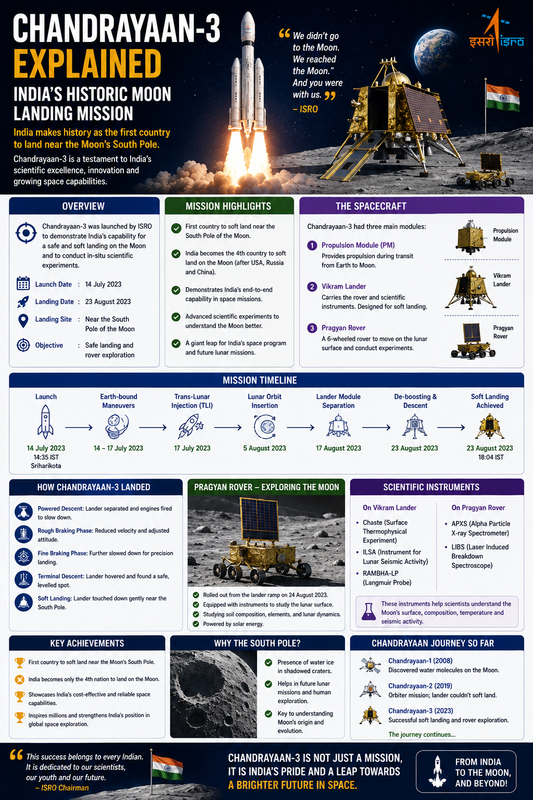
Chandrayaan
3 Explained: India's Historic Moon Landing Mission
Chandrayaan 3 remains one of ISRO's most celebrated
achievements, making India the first country to successfully land a spacecraft
near the Moon's south pole region, a historic milestone in global space
exploration that placed India among an elite group of nations capable of soft
lunar landings.
Mission
Objectives
Chandrayaan 3 was designed with three
primary objectives: to demonstrate a safe and soft landing on the lunar
surface, to showcase rover mobility and operations on the Moon, and to conduct
in-situ scientific experiments that would help scientists better understand the
composition and characteristics of the lunar surface.
Key
Components of the Mission
·
Lander module: Named Vikram, responsible
for the critical soft landing sequence on the lunar surface, involving a
carefully controlled descent to avoid a crash landing
·
Rover: Named Pragyan, deployed after a
successful landing to explore the surrounding lunar terrain, capture images and
conduct chemical composition experiments on the lunar soil
·
Propulsion module: Carried the lander
and rover from Earth orbit toward lunar orbit before separating, after which it
continued operating independently for further scientific study
Why
the South Pole Landing Was Significant
The Moon's south pole region is
scientifically important due to the potential presence of water ice trapped in
permanently shadowed craters that never receive direct sunlight. Confirming and
understanding these ice deposits is considered important for future lunar
exploration, since water ice could potentially support future human missions by
providing a source of drinking water, oxygen and even rocket fuel components.
How
Chandrayaan 3 Built on Previous Missions
The mission built directly on lessons
learned from the Chandrayaan 2 mission, which successfully placed an orbiter
around the Moon but faced significant challenges during its lander's final
descent phase, resulting in a hard landing. ISRO's engineering teams conducted
a thorough review of what went wrong with Chandrayaan 2 and incorporated
numerous design and software improvements into Chandrayaan 3's landing systems,
contributing significantly to its ultimate success.
Scientific
Findings and Contributions
Following its successful landing,
Chandrayaan 3's instruments conducted various experiments on the lunar surface,
including temperature measurements and soil composition analysis, contributing
valuable data to the global scientific community's understanding of lunar
surface conditions near the south pole.
Impact
on India's Space Programme and Global Standing
Chandrayaan 3's success significantly
boosted India's global standing in space exploration, demonstrating ISRO's
capability to execute complex interplanetary missions cost-effectively and
reliably. The mission's success is frequently cited as evidence of India's
growing technical capability in space science, and it has been widely
referenced in discussions about India's expanding role in international space
collaboration.
Why
This Mission Matters for Students
For engineering and science students,
Chandrayaan 3 serves as a powerful case study in iterative engineering:
learning systematically from a previous failure, making targeted design
improvements, and achieving success through careful, methodical problem-solving
rather than starting from scratch.
Final
Verdict
Chandrayaan 3 stands as one of the
defining achievements of India's space programme, demonstrating both technical
capability and cost-effective mission design. It continues to be referenced as
a benchmark for ISRO's growing role in global space exploration and remains a
source of national pride and inspiration for students pursuing careers in
science and engineering.