Gaganyaan Mission Explained: India's Human Spaceflight Programme in 2026
India's Gaganyaan mission is moving closer to launch. Here is a complete explanation of the mission, its timeline and what it means for India's space programme.
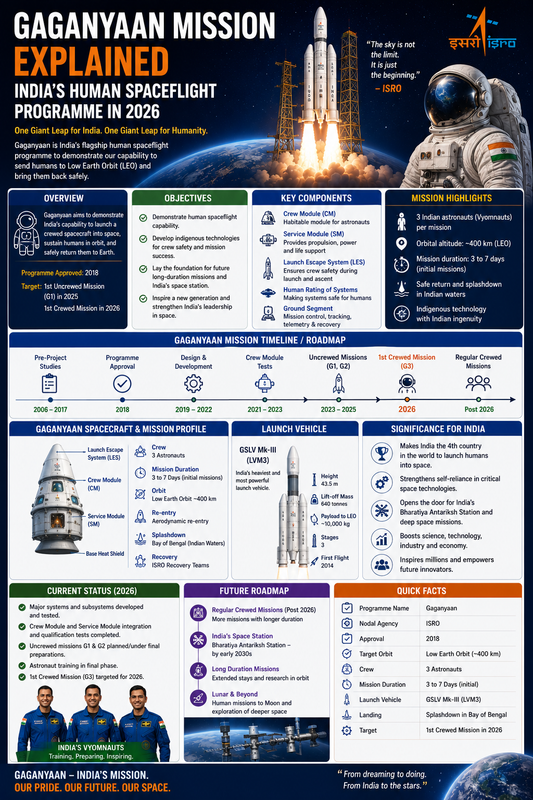
Gaganyaan
Mission Explained: India's Human Spaceflight Programme in 2026
Gaganyaan is India's ambitious human
spaceflight programme, aiming to send Indian astronauts into low Earth orbit
and safely bring them back, making India only the fourth nation to achieve
independent human spaceflight capability after the United States, Russia and
China.
What
the Gaganyaan Programme Involves
The programme uses the Human-Rated Launch
Vehicle Mark 3 (HLVM3), a human-rated version of ISRO's proven LVM3 rocket, to
carry a specially designed crew module and service module into orbit. Since
human spaceflight carries extraordinarily high safety stakes, ISRO is
conducting a rigorous series of uncrewed test missions to validate every
critical system before any astronaut boards the spacecraft.
The
Uncrewed Test Missions
·
G1 mission: The first uncrewed test
flight, which will carry Vyommitra, a female-featured humanoid robot designed
to simulate astronaut conditions and provide critical life-support and
environmental data
·
G2 and G3 missions: Additional uncrewed
test flights planned throughout 2026 to further validate spacecraft systems,
recovery procedures and safety mechanisms before any crewed launch
·
Extensive ground testing: Including
thousands of structural and system qualification tests, such as parachute
recovery tests and crew module propulsion system integration, conducted with a
reported success rate above 95 percent
Current
Status as of 2026
As of mid-2026, ISRO has completed
several major milestones, including successful crew module systems validation
tests and propulsion system integration testing. However, the exact launch date
for the G1 uncrewed mission has not been firmly confirmed, with various
official statements pointing to a target of late 2026, though officials have
acknowledged this could realistically slip into 2027 depending on the outcome
of final safety assessments. The eventual crewed mission, referred to as H1, is
being targeted for 2027, though this timeline has shifted multiple times since
the programme's original announcement and could shift further.
Why
the Timeline Keeps Shifting
Gaganyaan was originally targeted for a
much earlier launch, but has faced repeated delays as ISRO prioritizes safety
over speed for what would be India's first human spaceflight mission. This
cautious approach reflects the extremely high stakes involved: unlike uncrewed
satellite missions, any failure during a crewed mission would carry
catastrophic consequences, making exhaustive testing non-negotiable regardless
of external pressure to meet a specific date.
The
Astronauts Selected for the Programme
Four Indian Air Force officers have been
selected and trained as candidate astronauts for the Gaganyaan programme: Group
Captain Prasanth Balakrishnan Nair, Group Captain Ajit Krishnan, Group Captain
Angad Pratap and Group Captain Shubhanshu Shukla. Notably, Shukla's participation
in an international space station mission has provided ISRO with valuable
additional insight ahead of Gaganyaan's own crewed flight.
Why
Gaganyaan Matters for India
Beyond the historic achievement of
independent human spaceflight, Gaganyaan is also seen as a critical stepping
stone toward India's longer-term space ambitions, including building the
Bharatiya Antariksha Station, targeted for around 2035, and eventually landing
an Indian astronaut on the Moon, with a broader national goal set around 2040.
What
Students Can Learn From This Programme
Gaganyaan showcases the importance of
rigorous testing, systems engineering, redundancy planning and safety
validation in aerospace projects. For engineering students interested in
aerospace, robotics or systems design, following Gaganyaan's development offers
a real-world case study in how complex, high-stakes engineering programmes are
actually managed and de-risked over time.
Final
Verdict
Gaganyaan remains one of India's most
significant and closely watched space missions in 2026. While exact launch
dates continue to shift as ISRO prioritizes safety over speed, the programme
represents a major step toward India's long-term human spaceflight ambitions,
and its eventual success will mark one of the most significant milestones in
the country's space history.