ISRO Free Certificate Courses 2026: Complete List and How to Apply
ISRO and IIRS regularly offer free online courses with certificates. Here is a complete guide to ISRO's free courses in 2026 and how to enroll.
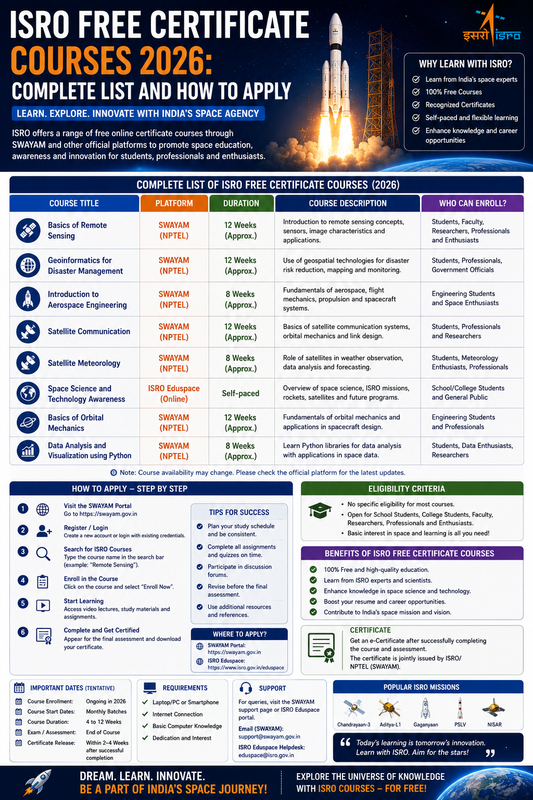
ISRO
Free Certificate Courses 2026: Complete List and How to Apply
ISRO, through its educational wing IIRS (Indian
Institute of Remote Sensing), regularly offers free online courses covering
remote sensing, geospatial technology and increasingly, AI and machine learning
applications, making space technology education accessible to students across
India at no cost.
Why
These Courses Have Become So Popular
In recent years, demand for ISRO's free
courses has grown significantly, partly because they are taught directly by
ISRO and IIRS scientists, offer an official government-issued certificate on
completion, and remain completely free of charge. For students building a
technical portfolio, especially in fields like geospatial technology or AI,
this combination is difficult to find elsewhere.
Types
of Free Courses Offered in 2026
·
AI/ML for Geodata Analysis: A course focused
on applying machine learning techniques to satellite and geospatial data, open
to undergraduates, postgraduates, research scholars and working professionals
·
Remote sensing techniques for geological applications: Covering satellite-based observations, geological mapping and
mineral exploration methods
·
Photogrammetry and LiDAR remote sensing courses: Covering advanced techniques like Photogrammetry and SAR
Interferometry, particularly relevant for civil engineering and geosciences
students
·
Space technology and applications training under the SETU programme: Specifically designed for school teachers to help them bring space
science concepts into classrooms
·
GIS and satellite data analysis fundamentals: Broader foundational courses on geospatial technology through the
IIRS Outreach Programme
Who
Can Apply
Eligibility varies by course. Many
courses are open to undergraduate and postgraduate students, research scholars,
faculty members and working professionals. Some courses, like the AI/ML for
Geodata Analysis programme, are broadly open to B.Tech, B.E., BCA and B.Sc.
students, along with M.Tech, MCA and M.Sc. postgraduates. Other courses,
particularly those focused on geological applications, are more narrowly
targeted at students and professionals from relevant academic backgrounds such
as geology, geophysics or civil engineering.
How
to Apply for ISRO Free Courses
Applications are typically submitted
through the IIRS e-learning portal, where candidates register with their
personal and academic details. Some courses require candidates to belong to a
university networked under the IIRS Outreach Programme, while others, including
several recent AI/ML-focused courses, accept individual registrations directly
without requiring institutional affiliation.
What
the Course Format Typically Looks Like
Most IIRS courses are conducted entirely
online through live and interactive sessions, often delivered through a
dedicated e-learning platform. Courses typically run for a set number of days,
ranging from short five-day programmes to more extended courses, with
attendance and, in some cases, quiz performance determining eligibility for the
final certificate.
Tips
to Get the Most Out of These Courses
·
Regularly check the official
IIRS and ISRO websites for new course announcements, as they are released
frequently throughout the year rather than on a fixed schedule
·
Meet the minimum attendance or
quiz score requirements to ensure you receive the certificate, since courses
often specify a required percentage of session participation
·
Choose courses aligned with
your academic background or career interests for maximum long-term value rather
than applying to every available course
·
Add completed certificates to
your resume and LinkedIn profile promptly, describing specifically what you
learned rather than just listing the course title
·
Be cautious of unofficial
sources charging fees for what are genuinely free ISRO programmes, and always
verify course details through official IIRS channels
Final
Verdict