ISRO Full Form, History and Headquarters: Everything You Need to Know
What does ISRO stand for and how did it begin? Here is a complete explanation of ISRO's full form, history and headquarters.
ISRO
Full Form, History and Headquarters: Everything You Need to Know
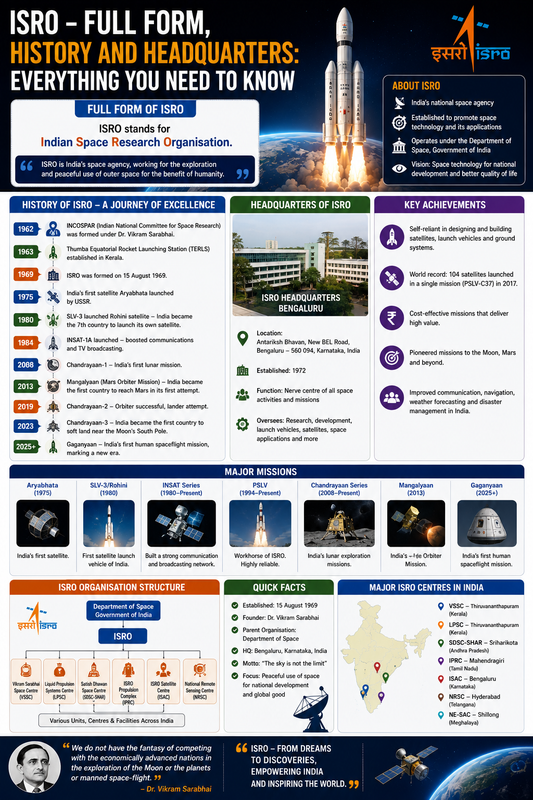
ISRO stands for the Indian Space Research
Organisation, the national space agency of India responsible for the country's
space research, satellite launches and interplanetary exploration missions. It
remains one of the most respected space agencies globally, known particularly
for its cost-effective mission design.
The
History Behind ISRO's Formation
ISRO's origins trace back to 1962, when
the Indian National Committee for Space Research (INCOSPAR) was formed under
the Department of Atomic Energy, with Dr. Vikram Sarabhai as its founding
chairperson. Dr. Sarabhai is widely regarded as the father of the Indian space
programme, having envisioned a role for space technology in solving practical
problems for India, such as communication, weather forecasting and resource
mapping, rather than purely for scientific prestige.
INCOSPAR was eventually reorganised into
ISRO in 1969, marking the formal beginning of India's dedicated space agency as
it exists today. In 1972, the Government of India established the Department of
Space and the Space Commission, bringing ISRO formally under the Department of
Space's administrative structure.
Where
ISRO Is Headquartered
ISRO's headquarters is located in
Bengaluru, Karnataka, though the organisation operates multiple specialized
centres across India, each focused on specific aspects of space research and
satellite technology. Key centres include the Vikram Sarabhai Space Centre in
Thiruvananthapuram, focused on launch vehicle technology; the Satish Dhawan
Space Centre in Sriharikota, which serves as ISRO's primary launch site; the
Liquid Propulsion Systems Centre, spread across Thiruvananthapuram and
Bengaluru; and the Space Applications Centre in Ahmedabad, focused on
satellite-based applications.
Key
Milestones in ISRO's History
·
Formation of INCOSPAR in 1962
under Dr. Vikram Sarabhai's leadership, marking the earliest institutional
roots of India's space programme
·
Official establishment of ISRO
in 1969, followed by the creation of the Department of Space in 1972
·
India's first satellite,
Aryabhata, launched in 1975 with assistance from the Soviet Union, marking
India's entry into space
·
Development of indigenous
launch vehicles, including the Polar Satellite Launch Vehicle (PSLV) and
Geosynchronous Satellite Launch Vehicle (GSLV), which reduced India's
dependence on foreign launch providers
·
A successful Mars orbital
mission achieved in a single attempt, making India the first country to succeed
on its maiden attempt to Mars
·
The Chandrayaan lunar
exploration missions, culminating in the historic south pole landing achieved
by Chandrayaan 3
·
Continued expansion into human
spaceflight through the ongoing Gaganyaan programme
How
ISRO Has Evolved Its Mission Focus Over Time
In its early decades, ISRO focused heavily
on building foundational satellite and launch capabilities aimed at practical
national needs, such as communication and remote sensing for agriculture and
disaster management. Over time, as these capabilities matured, ISRO expanded
into more ambitious scientific and exploratory missions, including
interplanetary missions to Mars and the Moon, and now human spaceflight through
Gaganyaan.
Why
Understanding ISRO's History Matters
For students preparing for competitive
exams or simply interested in India's space journey, understanding ISRO's
founding history and key milestones provides important context for appreciating
the scale of the organisation's more recent achievements. It also highlights
how India's space programme was deliberately built around practical,
developmental goals from its very inception, a philosophy that continues to
shape ISRO's mission priorities today.
Final
Verdict
ISRO, formally the Indian Space Research
Organisation, has grown from its origins as INCOSPAR in 1962 into one of the
world's most respected space agencies, headquartered in Bengaluru and operating
some of the most cost-effective space missions globally. Its journey from
foundational satellite technology to interplanetary exploration and human
spaceflight reflects a steady, deliberate progression built on decades of
institutional expertise.