ISRO Salary Structure 2026: What Scientists, Engineers and Assistants Earn
Curious about ISRO salaries in 2026? Here is a breakdown of pay structures for scientists, engineers and assistant-level posts.
ISRO
Salary Structure 2026: What Scientists, Engineers and Assistants Earn
ISRO, being a central government
scientific organisation, follows a structured pay scale based on the Central
Government's pay commission framework, with additional allowances that make
total compensation attractive compared to base pay alone. Understanding this
structure is important for candidates comparing an ISRO career against
private-sector engineering roles.
How
ISRO Salaries Are Structured
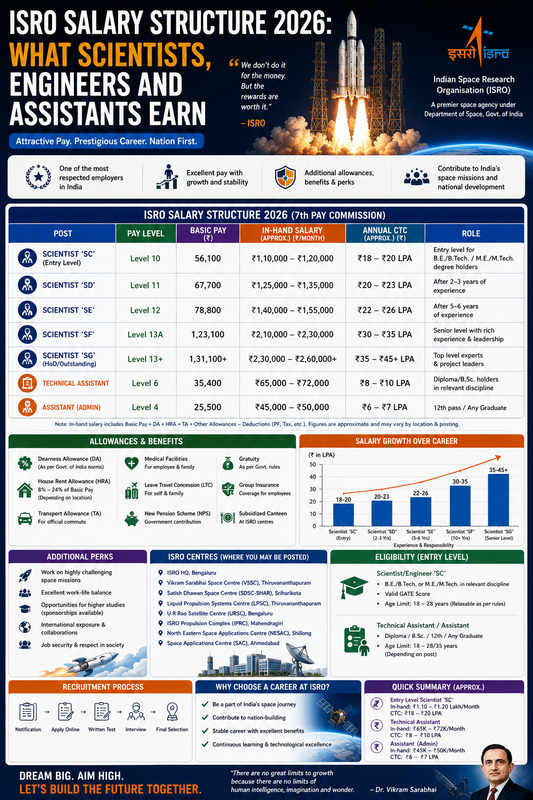
ISRO salaries are based on Pay Levels
under the Central Government pay matrix, with scientists and engineers
typically starting at a Pay Level significantly higher than administrative or
clerical posts. On top of basic pay, employees receive allowances including
House Rent Allowance, Dearness Allowance and Transport Allowance, all of which
combine to form the total in-hand salary.
Scientist
and Engineer Salaries
Entry-level Scientist and Engineer posts
at ISRO, typically at the Scientist/Engineer-SC level, usually start with a
basic pay in the Pay Level 10 range under the Central Government pay matrix.
Once Dearness Allowance, House Rent Allowance and other applicable allowances
are added, total in-hand salary generally works out to a competitive figure
compared to many private-sector engineering roles, especially when factoring in
the additional value of job security, pension benefits and career stability
that come with a central government position.
Career
Progression and Pay Growth
Scientists and engineers at ISRO
typically see periodic career progression through internal promotion schemes,
moving through higher Scientist/Engineer grades over the course of their
career, with corresponding increases in pay level and responsibility.
Long-serving scientists who reach senior leadership positions, including centre
directors or the ISRO Chairman position itself, are compensated at significantly
higher pay levels reflecting their seniority and responsibility.
Assistant
and Administrative Salaries
Assistant-level posts, including roles
like Upper Division Clerk (UDC), typically fall under lower pay levels compared
to scientist and engineer posts, generally starting in a lower Pay Level
bracket. While the basic pay is more modest compared to technical roles, these
positions still offer stable government benefits including allowances, pension
contributions, medical benefits and strong job security, making them attractive
for candidates seeking stable government employment.
Apprentice
and Technical Assistant Compensation
Apprentice positions at ISRO typically
offer a stipend rather than a full salary, in line with standard apprenticeship
norms, since these roles are primarily structured around skill development and
training rather than full-time employment. Technical Assistant posts, requiring
diploma-level technical qualifications, generally fall between apprentice
stipends and full scientist/engineer pay scales.
Additional
Benefits Beyond Basic Pay
·
Dearness Allowance, revised
periodically based on inflation to help offset rising living costs
·
House Rent Allowance, varying
based on the city classification of the posting location
·
Transport Allowance and other
standard central government employee benefits
·
Medical benefits, including
coverage under government health schemes
·
Pension scheme contributions
under the applicable government pension framework
·
Opportunities for career
progression through structured promotions and pay level increases over time
Why
ISRO Remains an Attractive Employer Despite Private-Sector Competition
Beyond salary figures alone, ISRO offers
job stability that is difficult to find in the private sector, the opportunity
to work on globally significant space missions, and a strong sense of national
contribution, which many candidates value highly alongside compensation when
choosing between a government scientific career and private industry roles.
Final
Verdict