Social Media and Mental Health: What the Research Actually Shows
Does social media really harm mental health? Here is a balanced look at what current research actually shows about the connection.
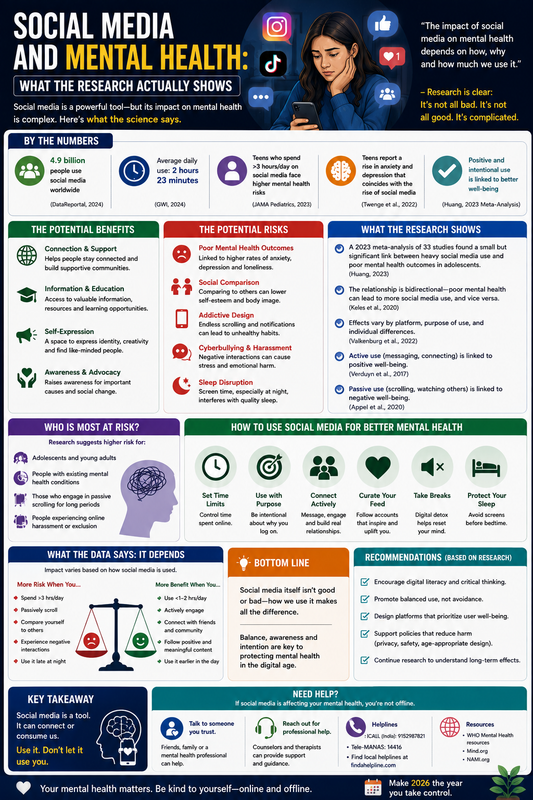
Social
Media and Mental Health: What the Research Actually Shows
The relationship between social media and
mental health remains one of the most widely debated topics in psychology and
public health, with research showing a more nuanced picture than simple
"social media is good" or "social media is bad" narratives
suggest.
What
Research Generally Agrees On
Most researchers agree that the
relationship between social media and mental health is complex and depends
heavily on how a platform is used, rather than simply how much time is spent on
it. Passive scrolling through curated, idealized content tends to correlate
more strongly with negative mood and body image concerns, while active
engagement, such as meaningful conversations with friends, tends to show more
neutral or even positive associations.
Groups
That Appear More Vulnerable
·
Teenagers and young adults,
whose identity and social comparison instincts are still developing
·
Individuals who already
struggle with anxiety, depression or low self-esteem before increased social
media use
·
Users who primarily engage in
passive consumption rather than active social interaction
·
People who base significant
portions of their self-worth on likes, comments or follower counts
Common
Mechanisms Linking Social Media to Mental Health Effects
·
Social comparison, where users
compare their everyday lives to others' curated highlight reels
·
Fear of missing out, driven by
constant visibility into others' social activities
·
Sleep disruption caused by
late-night scrolling, which independently affects mood and mental health
·
Cyberbullying and negative
social interactions, which can have a direct emotional impact
Where
Social Media Can Have Positive Effects
Research also highlights genuine
benefits, including maintaining relationships across distances, finding
supportive communities around shared interests or health conditions, and
providing access to mental health information and resources that might
otherwise be difficult to find.
How
to Use Social Media in a Healthier Way
·
Prioritize platforms and
content that leave you feeling genuinely positive rather than anxious or
inadequate
·
Engage actively through
comments and conversations rather than passively scrolling
·
Curate your feed intentionally,
unfollowing accounts that consistently trigger negative comparison
·
Set boundaries around usage,
particularly around bedtime and immediately after waking up
Final
Verdict
Research in 2026 continues to show that
social media's impact on mental health depends heavily on how it is used, who
is using it, and what kind of content they engage with, rather than screen time
alone. Being intentional about usage patterns matters more than simply trying
to eliminate social media altogether.