Software Architecture Explained: A Beginner's Guide for 2026
What exactly is software architecture, and why does it matter so much? Here is a beginner-friendly explanation for 2026.
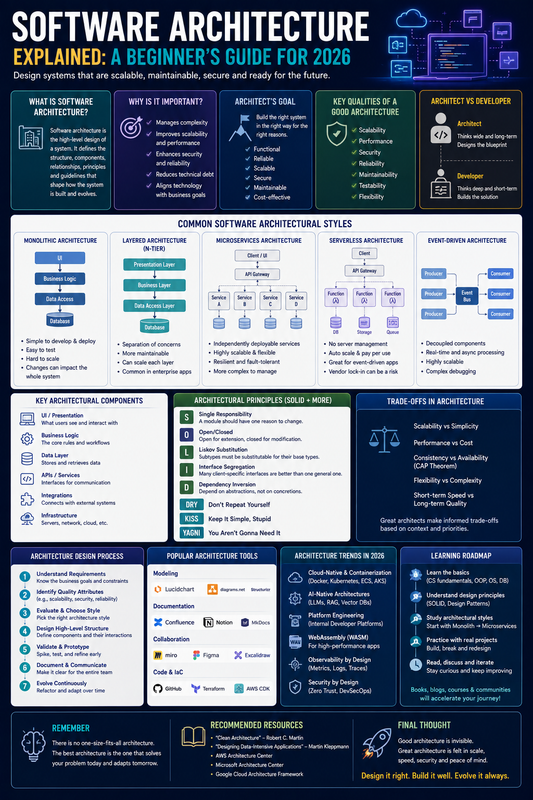
Software
Architecture Explained: A Beginner's Guide for 2026
Software architecture refers to the
high-level structure of a software system, defining how different components
interact, how data flows through the system, and how the overall system is
designed to meet requirements like scalability, reliability and
maintainability.
Why
Software Architecture Matters So Much
Poor architectural decisions made early
in a project can become extremely costly to fix later, as systems grow larger
and more complex. Strong architectural planning helps ensure a system can scale
to handle growth, remain maintainable as new features are added, and avoid
becoming excessively fragile or difficult to modify over time.
Core
Concepts Every Beginner Should Understand
·
Modularity: Breaking a system into
distinct, manageable components rather than one large, tightly coupled codebase
·
Scalability: Designing systems that can
handle increasing load without requiring a complete redesign
·
Separation of concerns: Ensuring
different parts of a system handle distinct responsibilities rather than
overlapping unnecessarily
·
Data flow and storage design: Planning
how data moves through a system and how it is stored, accessed and secured
Common
Software Architecture Patterns
·
Monolithic architecture, where an entire
application is built and deployed as a single, unified unit, simpler to develop
initially but potentially harder to scale over time
·
Microservices architecture, where an
application is broken into smaller, independently deployable services, offering
more flexibility and scalability at the cost of increased operational
complexity
·
Service-oriented architecture (SOA), an
earlier approach to building modular systems through reusable services, which
influenced the later development of microservices
·
Event-driven architecture, where system
components communicate through events rather than direct calls, often used in
systems requiring high responsiveness to real-time data
How
Architects Make Difficult Tradeoffs
Much of software architecture involves
navigating genuine tradeoffs rather than finding a single "correct"
answer, such as balancing system simplicity against future scalability needs,
or weighing development speed against long-term maintainability. This is often
referred to as dealing with the "hard parts" of software
architecture, since these decisions rarely have a universally right answer and
depend heavily on specific business and technical context.
The
Role of a Software Architect
A software architect is typically
responsible for making these high-level structural decisions, working closely
with development teams to ensure the overall system design supports both
current requirements and reasonable future growth, while also mentoring
engineers on architectural best practices.
How
Students Can Start Learning Software Architecture
Students can begin building architectural
understanding by studying how well-known, large-scale systems are designed,
working on personal projects that intentionally practice modular design
principles, and gradually exploring more advanced patterns like microservices
as their understanding of foundational concepts solidifies.
Final
Verdict