Software as a Service (SaaS) Explained: How It Works in 2026
SaaS has become the dominant software delivery model. Here is a clear explanation of how SaaS works and why it matters for businesses in 2026.
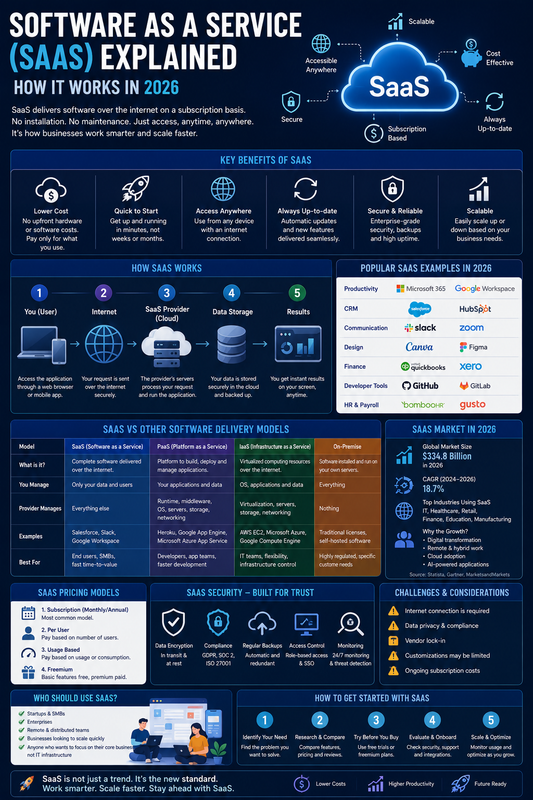
Software
as a Service (SaaS) Explained: How It Works in 2026
Software as a Service, commonly known as
SaaS, refers to a software delivery model where applications are hosted
centrally by a provider and accessed by users over the internet, typically
through a web browser, rather than being installed and run locally on
individual computers.
How
SaaS Differs From Traditional Software
Traditional software historically
required users to purchase a license, install the application directly on their
computer, and manage updates manually. SaaS applications, by contrast, are
hosted on the provider's servers, updated centrally without requiring user
action, and typically accessed through a subscription rather than a one-time
purchase.
Why
SaaS Has Become So Dominant
·
Lower upfront costs for
businesses, since SaaS typically uses a subscription model rather than large
upfront licensing fees
·
Automatic updates and
maintenance handled entirely by the provider, reducing the burden on internal
IT teams
·
Easier scalability, allowing
businesses to adjust their subscription level as their needs grow or shrink
·
Accessibility from any device
with an internet connection, supporting remote and distributed teams
effectively
Common
Examples of SaaS Applications
SaaS spans a huge range of business
functions, including customer relationship management platforms, project management
and collaboration tools, accounting and invoicing software, human resources
platforms, and communication tools, nearly all of which have shifted toward
this hosted, subscription-based model over the past decade.
The
SaaS Business Model Explained
SaaS companies typically generate revenue
through recurring subscription fees, often structured in tiers based on usage
level, number of users, or feature access. This recurring revenue model creates
a strong incentive for SaaS companies to focus heavily on customer retention
and ongoing product improvement, since revenue depends on customers continuing
to renew rather than a single upfront purchase.
Advantages
of SaaS for Businesses
·
Reduced need for significant
upfront capital investment in software and infrastructure
·
Faster deployment, since
businesses can begin using a SaaS product almost immediately after signing up
·
Reduced internal IT burden,
since maintenance, security patching and infrastructure management are handled
by the provider
·
Easier integration with other
SaaS tools through APIs, supporting more connected business workflows
Potential
Downsides and Considerations
·
Ongoing subscription costs can
become significant over time compared to a traditional one-time software
purchase
·
Businesses become dependent on
the SaaS provider's continued operation, pricing decisions and feature roadmap
·
Data security and privacy
considerations become important, since sensitive business data is hosted
externally
·
Limited customization compared
to fully custom-built internal software solutions
Why
This Matters for Students and Aspiring Entrepreneurs
Understanding the SaaS business model is
particularly valuable for students interested in building their own software
products or startups, since SaaS remains one of the most common and proven
business models for software-based businesses today.
Final
Verdict