Software Testing Career Guide 2026: Skills, Jobs and Salary
Considering a career in software testing? Here is a complete guide covering the skills, career path, job opportunities and salary expectations in 2026.
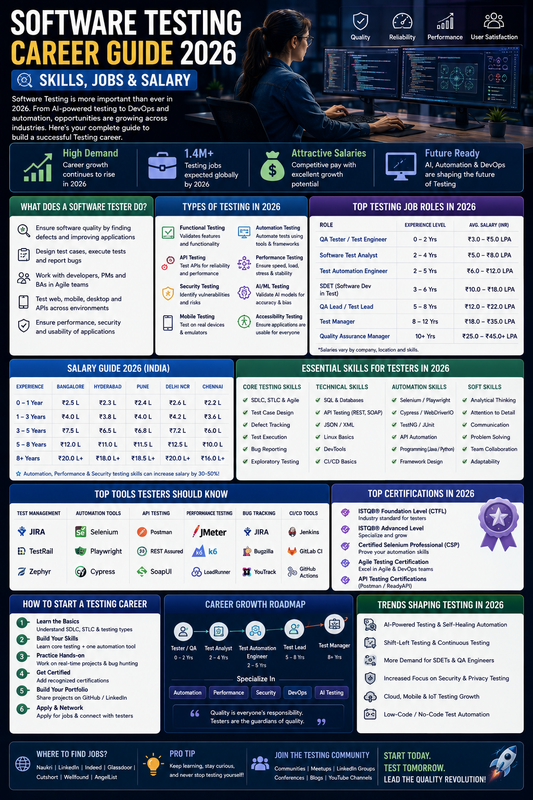
Software
Testing Career Guide 2026: Skills, Jobs and Salary
Software testing remains an essential and
consistently in-demand career path within the broader software industry,
ensuring that applications function correctly, securely and reliably before
reaching end users.
Why
Software Testing Remains a Valuable Career Path
As software systems become increasingly
complex and interconnected, the cost of undetected bugs and failures has grown
significantly, making skilled software testers an essential part of any serious
development team rather than an afterthought in the development process.
Understanding
the Software Testing Life Cycle
The software testing life cycle typically
includes several key stages: requirement analysis, test planning, test case
development, test environment setup, test execution, and defect reporting and
tracking, followed by test closure once quality benchmarks are met.
Understanding this structured process is fundamental to working effectively as
a tester.
Types
of Software Testing Roles
·
Manual testers, who execute test cases
directly and identify issues through hands-on exploration of an application
·
Automation testers, who write scripts and
use tools to automate repetitive testing processes
·
Performance testers, focused
specifically on how an application behaves under load and stress conditions
·
Security testers, focused on identifying
vulnerabilities and security weaknesses in an application
·
QA leads and test managers, responsible
for overall test strategy and team coordination
Essential
Skills for a Software Testing Career
·
Strong understanding of
software development processes and how testing fits into the broader
development life cycle
·
Attention to detail and strong
analytical thinking to identify edge cases and potential failure points
·
Familiarity with test
automation tools and, ideally, basic programming or scripting skills for
automation-focused roles
·
Understanding of different
testing types, including functional, regression, performance and security
testing
·
Clear documentation and
communication skills for reporting defects effectively to development teams
How
to Start a Career in Software Testing
Many software testing courses are available
covering both manual and automation testing fundamentals, and while formal
courses can help build foundational knowledge, hands-on practice testing real
or sample applications tends to be equally, if not more, valuable for building
genuine practical skill.
Common
Interview Topics for Software Testing Roles
Software testing interviews typically
cover topics like the software testing life cycle, different types of testing,
how to write effective test cases, basic automation tool familiarity, and scenario-based
questions asking candidates to identify potential test cases for a given
feature or application.
Salary
and Career Growth in Software Testing
Software testing salaries vary based on
experience, specialization and whether the role focuses on manual or automation
testing, with automation and performance testing skills generally commanding
higher compensation due to their more specialized technical requirements.
Career growth often leads toward QA leadership, test architecture roles, or a
transition into broader software development roles.
Final
Verdict
Software testing in 2026 remains a
stable, in-demand career path within the technology industry, particularly for
candidates who develop strong automation and technical testing skills alongside
traditional manual testing fundamentals. It also serves as a solid entry point
for candidates interested in eventually transitioning into broader software
development roles.