Top 25 AI Mini Projects for Students (2026) – Complete Guide with Source Code Ideas
Explore the best AI mini projects for beginners and engineering students. Learn project ideas, technologies, implementation steps, and how to build each project from scratch.
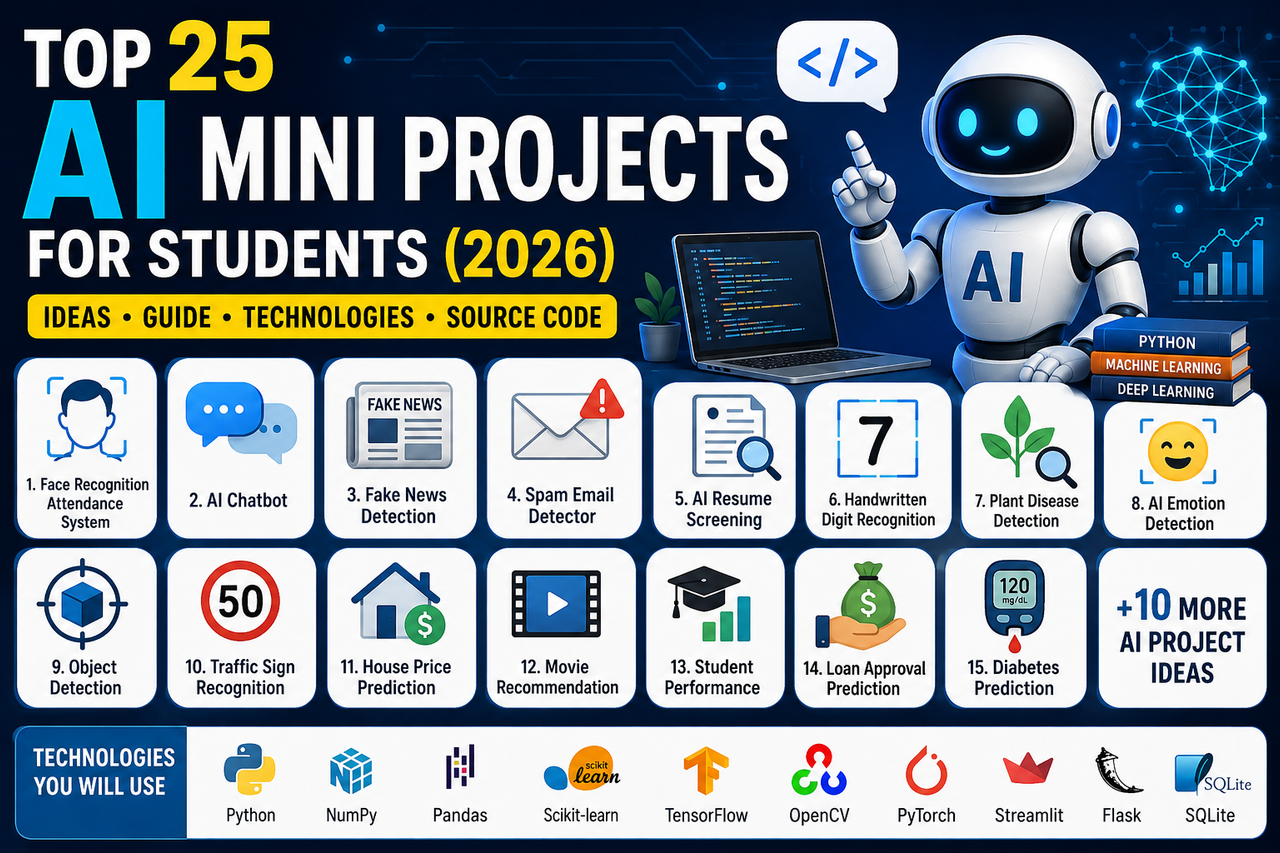
Top 25 AI Mini Projects for Students (2026)
Artificial Intelligence (AI) is transforming every industry, including healthcare, finance, education, agriculture, and cybersecurity. Building AI mini projects is one of the best ways to improve your programming skills and prepare for internships and placements.
This guide explains some of the best AI mini projects, the technologies required, and the steps to build them.
Why Build AI Mini Projects?
AI projects help you:
- Improve Python programming skills
- Learn Machine Learning algorithms
- Build an impressive portfolio
- Prepare for interviews
- Understand real-world AI applications
- Gain hands-on experience
Technologies Required
- Python
- NumPy
- Pandas
- Matplotlib
- Scikit-learn
- TensorFlow
- PyTorch
- OpenCV
- Flask/Django
- Streamlit
- SQLite/MySQL
AI Project Development Roadmap
Step 1
Choose a problem.
Example:
- Disease Prediction
- Face Recognition
- Chatbot
- Object Detection
Step 2
Collect Dataset
Sources
- Kaggle
- UCI Repository
- Google Dataset Search
- HuggingFace Datasets
Step 3
Preprocess Data
- Remove missing values
- Normalize data
- Encode labels
- Split training and testing datasets
Step 4
Train AI Model
Popular Algorithms
- Linear Regression
- Logistic Regression
- Decision Tree
- Random Forest
- Support Vector Machine
- KNN
- CNN
- LSTM
Step 5
Evaluate Model
Metrics
- Accuracy
- Precision
- Recall
- F1 Score
- Confusion Matrix
Step 6
Deploy the Model
You can deploy using
- Flask
- Django
- Streamlit
- FastAPI
Best AI Mini Projects
1. Face Recognition Attendance System
Technologies
- Python
- OpenCV
- Face Recognition
- SQLite
Features
- Detect faces
- Mark attendance
- Store records
- Export attendance
Difficulty
Beginner
2. AI Chatbot
Technologies
- Python
- NLP
- Transformers
- Flask
Features
- Answer questions
- Context understanding
- Voice support
- Database integration
Difficulty
Easy
3. Fake News Detection
Technologies
- Machine Learning
- NLP
- Scikit-learn
Features
- Detect fake news
- Classify articles
- Probability score
Difficulty
Intermediate
4. Spam Email Detector
Technologies
- Python
- Naive Bayes
- NLP
Features
- Detect spam
- Email classification
- Accuracy report
5. AI Resume Screening System
Technologies
- NLP
- Python
- Flask
Features
- Resume parsing
- Skill matching
- Candidate ranking
6. Handwritten Digit Recognition
Technologies
- TensorFlow
- CNN
- MNIST Dataset
Features
- Recognize handwritten numbers
- Live drawing prediction
7. Plant Disease Detection
Technologies
- CNN
- TensorFlow
- OpenCV
Features
- Detect crop diseases
- Suggest treatments
8. AI Emotion Detection
Technologies
- OpenCV
- CNN
Features
- Detect happy
- Sad
- Angry
- Neutral
9. Object Detection
Technologies
- YOLO
- OpenCV
Features
- Detect multiple objects
- Live webcam detection
10. Traffic Sign Recognition
Technologies
- Deep Learning
- CNN
Features
- Road sign detection
- Classification
11. House Price Prediction
Technology
- Linear Regression
12. Movie Recommendation System
Technology
- Collaborative Filtering
13. Student Performance Prediction
Technology
- Random Forest
14. Loan Approval Prediction
Technology
- Decision Tree
15. Diabetes Prediction
Technology
- Machine Learning
16. Weather Prediction
Technology
- Time Series Analysis
17. Voice Assistant
Technology
- Speech Recognition
18. AI Translator
Technology
- NLP
19. OCR Text Scanner
Technology
- Tesseract OCR
20. AI Image Classifier
Technology
- CNN
21. Number Plate Detection
Technology
- OpenCV
22. Fire Detection System
Technology
- YOLO
23. Human Pose Detection
Technology
- MediaPipe
24. Mask Detection System
Technology
- TensorFlow
25. AI Virtual Mouse
Technology
- OpenCV
- MediaPipe
Best Datasets
- MNIST
- CIFAR-10
- COCO Dataset
- IMDB Reviews
- Iris Dataset
- Titanic Dataset
- Kaggle Datasets
- ImageNet
Tips for Building AI Projects
- Start with simple datasets.
- Keep your code modular.
- Document your project.
- Use GitHub for version control.
- Test with multiple datasets.
- Build a user-friendly interface.
- Deploy your project online.
- Include screenshots and documentation.
Conclusion
AI mini projects are the best way to gain practical experience in Artificial Intelligence and Machine Learning. Whether you are a beginner or an engineering student, these projects help you understand real-world AI development, improve coding skills, and build a strong portfolio for internships and placements.
Start with simple projects like spam detection or house price prediction, then move to advanced applications such as face recognition, object detection, and AI chatbots. Consistent practice will help you become a confident AI developer.
Frequently Asked Questions (FAQ)
Which AI project is best for beginners?
Spam Email Detection, House Price Prediction, and Face Recognition Attendance are great beginner-friendly projects.
Which programming language is best for AI?
Python is the most widely used language for Artificial Intelligence because of its rich ecosystem of libraries.
Can I build AI projects without deep learning?
Yes. Many useful AI projects use classical machine learning algorithms like Decision Trees, Random Forest, and Logistic Regression.
Which AI projects are suitable for final-year engineering students?
Face Recognition, Plant Disease Detection, AI Chatbots, Object Detection, Resume Screening, and Emotion Detection are excellent final-year project choices.
Where can I get datasets for AI projects?
You can download free datasets from Kaggle, the UCI Machine Learning Repository, Google Dataset Search, and Hugging Face Datasets.
Suggested article URL:
https://searchcreators.org/blog/top-ai-mini-projects-2026