50 Important VTU Major Project Viva Questions and Answers
Prepare for your VTU major-project viva with 50 important questions covering project concepts, technologies, architecture, database, algorithms, testing, and individual contribution.
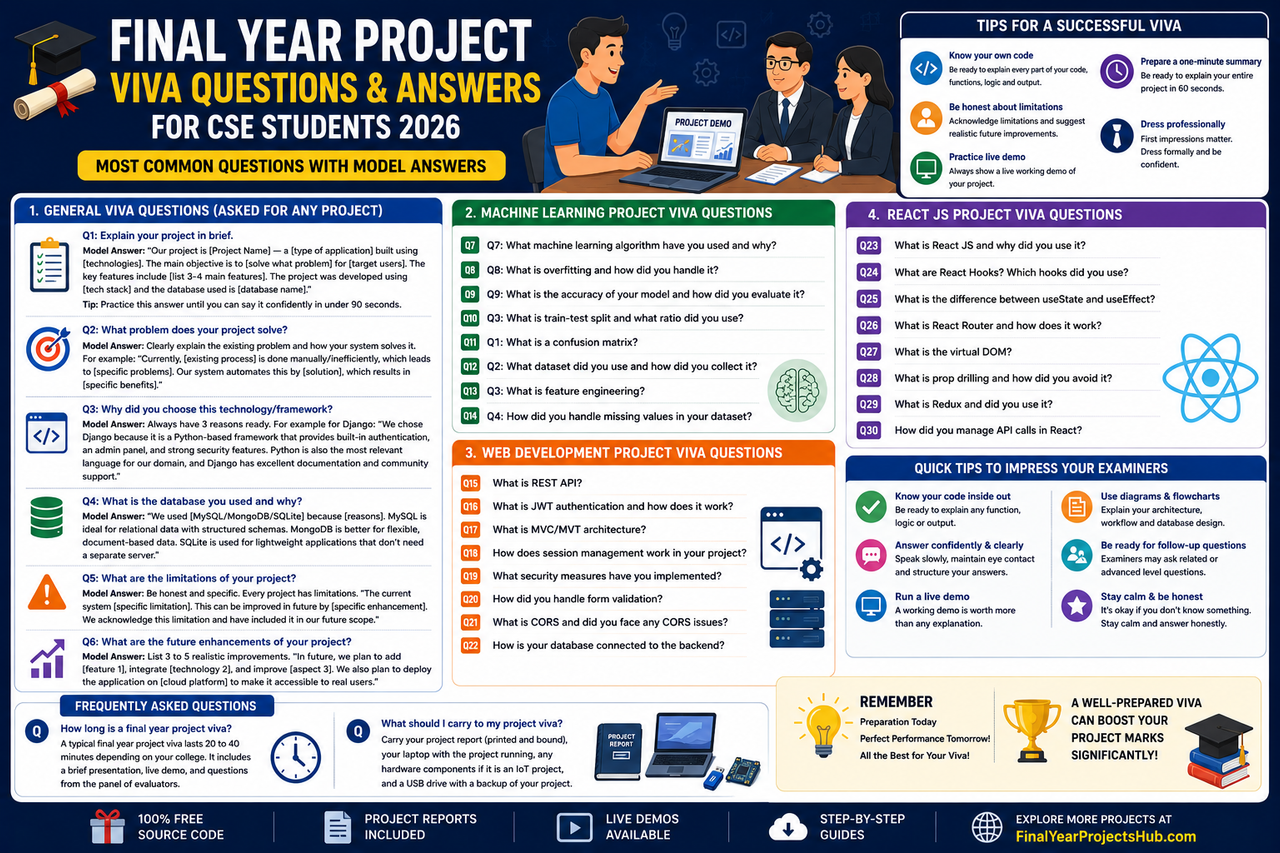
50 VTU Major Project Viva Questions and Answers
The major-project viva evaluates whether students understand
their project.
Evaluators may ask questions about the project concept,
modules, technologies, algorithms, database, testing, results, and individual
contribution.
Students should answer based on their actual project.
General Project Questions
1. What is your project title?
State the complete approved title clearly.
2. What problem does your project solve?
Explain the real-world problem in two or three sentences.
3. Why did you select this project?
Mention the practical need, interest, social value, or
technical learning.
4. Who are the target users?
Identify the people or organizations that will use the
system.
5. What is the main objective?
Explain the most important outcome expected from the
project.
6. What are the secondary objectives?
Mention additional goals such as automation, accuracy,
security, and time reduction.
7. What is the existing system?
Explain how the problem is currently handled.
8. What are the limitations of the existing system?
Mention manual work, delays, errors, cost, poor security, or
limited accessibility.
9. What is your proposed system?
Explain the solution developed by your team.
10. What are the major advantages?
Mention speed, accuracy, usability, automation,
accessibility, or reduced effort.
Technology Questions
11. Which programming language did you use?
State the language and explain why it was suitable.
12. Which framework did you use?
Mention Django, Flask, React, Flutter, Spring Boot, or another
framework.
13. Why did you choose this framework?
Explain its development speed, security, libraries, or
suitability.
14. Which database did you use?
Mention MySQL, SQLite, MongoDB, Firebase, or PostgreSQL.
15. Why did you select this database?
Explain based on project size, data structure, availability,
and integration.
16. Which development tools were used?
Mention VS Code, Android Studio, Jupyter Notebook, Git, or
other tools.
17. Did you use an external API?
Explain the API purpose and integration.
18. Did you use third-party libraries?
Mention the important libraries and their purpose.
19. How is your frontend connected to the backend?
Explain forms, API requests, routes, or server responses.
20. How is the backend connected to the database?
Explain database models, queries, or object-relational
mapping.
Architecture and Module Questions
21. Explain your system architecture.
Describe the flow from user input to processing, database,
and output.
22. What are the major modules?
List the modules and explain their responsibilities.
23. Explain the user module.
Describe the functions available to the user.
24. Explain the admin module.
Describe user management, data control, reports, and
monitoring.
25. What happens when a user submits data?
Explain validation, processing, database storage, and
response generation.
26. What is the purpose of the use-case diagram?
It represents interactions between users and the system.
27. What is the purpose of the sequence diagram?
It shows how different components communicate over time.
28. What does the activity diagram represent?
It represents the workflow of a process.
29. Explain your database design.
Describe the main tables, fields, and relationships.
30. What is a primary key?
A primary key uniquely identifies a database record.
AI and Machine Learning Questions
31. Which algorithm did you use?
State the algorithm used in your project.
32. Why did you choose this algorithm?
Explain its suitability, performance, simplicity, or
accuracy.
33. What dataset did you use?
Mention the dataset source, size, features, and classes.
34. How did you preprocess the data?
Explain missing-value handling, normalization, resizing,
encoding, or cleaning.
35. How did you divide the dataset?
Explain training, validation, and testing data.
36. What is model training?
Training is the process of learning patterns from data.
37. What is model testing?
Testing evaluates the model using previously unseen data.
38. What accuracy did your model achieve?
State the actual measured result. Do not invent a value.
39. What is a confusion matrix?
It shows correct and incorrect predictions for each class.
40. What are precision and recall?
Precision measures the correctness of positive predictions.
Recall measures how many actual positive cases were identified.
Testing and Security Questions
41. How did you test the application?
Explain functional, validation, integration, and system
testing.
42. What happens when invalid data is entered?
Explain input validation and error messages.
43. How are passwords protected?
Explain hashing, authentication, and access control used in
the project.
44. How do you prevent unauthorized access?
Mention login validation, roles, permissions, and protected
routes.
45. What are the limitations of your project?
State genuine limitations such as dataset size, internet
dependency, or limited deployment.
Contribution and Future Questions
46. What was your individual contribution?
Explain the modules, documentation, testing, or design
completed by you.
47. How did your team divide the work?
Explain each member’s responsibility.
48. What challenges did you face?
Mention technical errors, dataset problems, integration
issues, or time constraints.
49. How did you solve those challenges?
Explain the debugging, research, testing, or alternative
solution used.
50. What is the future scope?
Mention realistic improvements such as mobile support, cloud
deployment, more data, and additional modules.
Viva Preparation Tips
- Understand
every module.
- Do
not memorize without understanding.
- Practice
a short project explanation.
- Know
your database.
- Know
the algorithm.
- Know
your contribution.
- Keep
the project ready for demonstration.
- Prepare
backup screenshots.
- Answer
honestly when unsure.
- Avoid
arguing with evaluators.
Conclusion