Building an AI-Powered Disease Prediction System Using Machine Learning
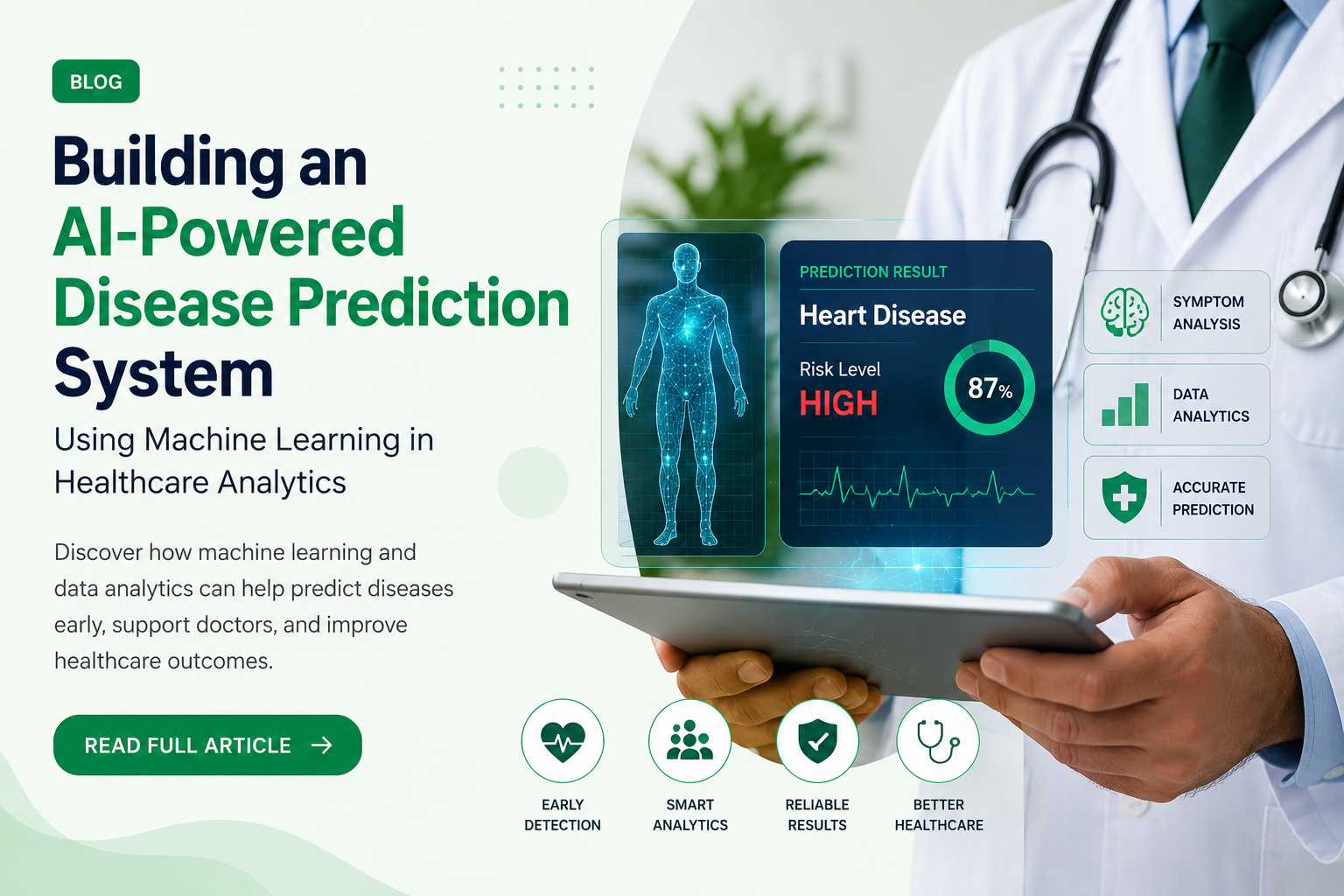
Healthcare is rapidly evolving with the help of Artificial Intelligence and Machine Learning. One of the most impactful applications of AI in healthcare is disease prediction. Predicting diseases at an early stage can help doctors make faster decisions, improve treatment quality, and reduce medical risks. This is exactly where the Disease Prediction System comes into the picture.
The Disease Prediction System is a healthcare analytics project developed using Machine Learning algorithms to predict diseases based on patient medical data and symptoms. Instead of relying completely on manual analysis, the system uses data-driven intelligence to analyze patient conditions and provide quick predictions.
The idea behind this project is simple but powerful. A patient enters medical details such as age, gender, fever, cough, headache, blood pressure, sugar level, cholesterol, and medical history. The system processes this data using trained Machine Learning models and predicts the most probable disease. In our project, diseases such as Flu and Heart Disease were predicted based on healthcare parameters.
One of the main goals of this project was to support doctors and healthcare professionals during diagnosis. In traditional healthcare systems, diagnosis can sometimes be time-consuming because it depends heavily on human expertise and manual symptom analysis. By using Machine Learning, the prediction process becomes faster, smarter, and more efficient.
The project was developed using Python, Google Colab, and Streamlit. Python was chosen because of its powerful ecosystem for AI and data science projects. Several important libraries were used throughout development. Pandas helped in handling and preprocessing healthcare datasets, NumPy was used for numerical operations, Matplotlib and Seaborn were used for data visualization, and Scikit-learn was used for building and evaluating Machine Learning models. Streamlit was used to transform the Machine Learning model into a professional and interactive healthcare web application.
The dataset used in the project contained patient information such as symptoms, blood pressure, sugar level, cholesterol level, age, gender, and medical history. Before training the model, the dataset went through a complete preprocessing pipeline. Missing values were checked, categorical data like gender and medical history were converted into numerical form using Label Encoding, and feature scaling was applied using StandardScaler to improve model performance.
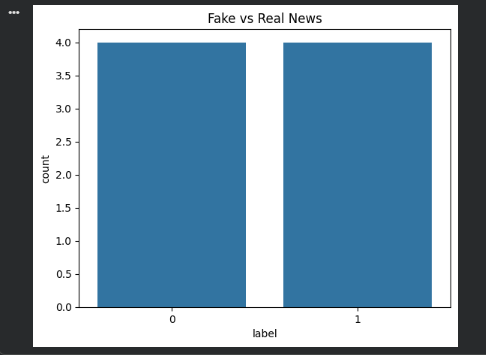
A major part of the project involved Exploratory Data Analysis (EDA). Different graphs and visualizations were created to understand how medical attributes affect disease prediction. Heatmaps, count plots, and distribution graphs helped identify patterns and correlations within the healthcare data. For example, factors like sugar level, cholesterol, and blood pressure showed strong relationships with disease outcomes.
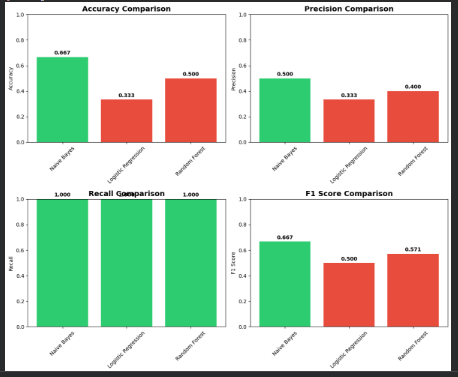
Instead of using only one Machine Learning algorithm, multiple classification models were implemented and compared. Logistic Regression, Decision Tree, Random Forest, Naive Bayes, and Support Vector Machine (SVM) were trained using the healthcare dataset. This helped determine which algorithm performed best for disease prediction. Among these models, Random Forest delivered higher accuracy and better overall performance.
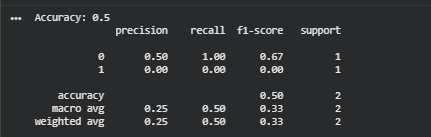
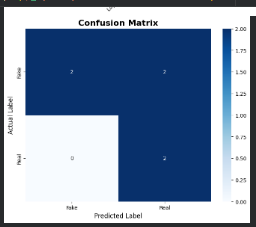
The dataset was divided into training and testing sets using an 80:20 ratio. The training data helped the models learn patterns from healthcare information, while the testing data evaluated how accurately the models could predict unseen cases. Performance evaluation was done using Accuracy, Precision, Recall, F1-Score, and Confusion Matrix analysis.
To make the project more advanced and industry-ready, several modern AI techniques were added. Cross-validation was used to ensure that the model performs consistently across different data samples and avoids overfitting. ROC Curve analysis was implemented to visually evaluate the classification performance of the model.
One of the most interesting advanced features used in the project was Feature Importance Analysis. This technique helped identify which medical parameters contributed the most to disease prediction. Features like sugar level, cholesterol, age, and blood pressure played a significant role in prediction outcomes. This made the system more explainable and transparent, which is very important in healthcare applications.
Another useful feature added to the project was Risk Level Prediction. Based on sugar level and cholesterol values, the system categorizes patients into Low Risk, Medium Risk, or High Risk groups. This provides additional healthcare insights beyond simple disease prediction and helps doctors understand the severity of patient conditions.
The project also included a modern and interactive Streamlit web application. Instead of running predictions only inside notebooks, the Machine Learning model was integrated into a professional healthcare dashboard. Users can enter patient details through an attractive UI and instantly receive disease predictions along with risk analysis. The application was enhanced with custom UI design, animations, charts, explainable AI graphs, and responsive layouts to create a real-world healthcare experience.
To improve efficiency, the trained Machine Learning model was saved using Pickle serialization. The saved .pkl files allow the Streamlit application to load the trained model directly without retraining every time the application starts. This makes the system faster and more practical for real-world use.
This project demonstrates how Artificial Intelligence and Machine Learning can transform healthcare analytics. It combines data science, predictive analytics, explainable AI, visualization, and web application development into one complete healthcare solution. The Disease Prediction System not only improves disease prediction speed and accuracy but also supports smarter healthcare decision-making.
In the future, this system can be enhanced further by integrating deep learning models, real-time patient monitoring, wearable device data, cloud deployment, mobile healthcare applications, and AI-powered healthcare assistants. With further improvements, AI-driven healthcare systems like this can become an important part of modern medical technology and digital healthcare transformation.
RESULTS