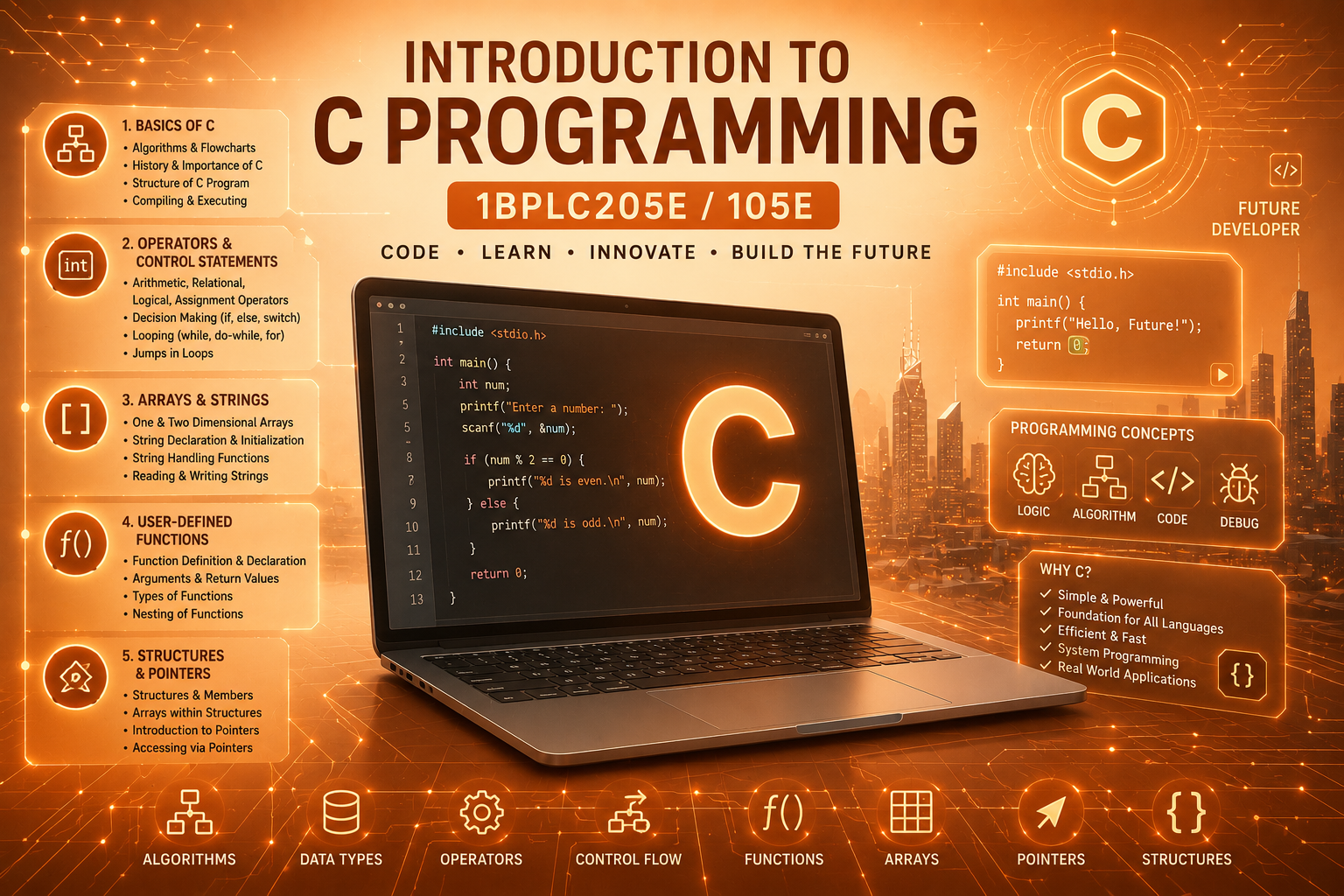
Module 1 – Introduction to C Programming and Algorithms
This module introduces the basics of programming using algorithms, flowcharts, and the C programming language. Students learn the history, importance, and structure of C programs along with coding standards and execution methods. Concepts like constants, variables, data types, keywords, and input/output statements are explained clearly. The module helps students understand how programs are written and executed step by step. It also develops logical thinking and problem-solving skills through simple programming concepts. Overall, this module builds a strong foundation for learning programming in C.
Click to get the Module1
Module 2 – Operators and Control Statements
This module focuses on operators and decision-making statements used in C programming. Students learn arithmetic, relational, logical, assignment, and conditional operators with practical examples. Different control structures like if, if-else, switch, and loops such as while, do-while, and for are explained in detail. Concepts like nested conditions and jump statements are also introduced. These programming structures help in controlling the flow of execution in a program. Overall, the module improves coding logic and helps students create interactive programs.
Click to get the Module2
Module 3 – Arrays and Strings
This module explains how arrays and strings are used for storing and processing multiple data values. Students learn one-dimensional and two-dimensional arrays along with their declaration and initialization methods. String handling concepts such as reading, writing, comparing, and manipulating strings are also covered. Various string handling functions are introduced for efficient text processing. The module also includes simple programs using arrays and strings for problem-solving. Overall, it helps students understand data organization and manipulation techniques in C programming.
Click to check the Module3
Module 4 – User-defined Functions
This module introduces user-defined functions and their importance in modular programming. Students learn how to create functions, pass arguments, and return values in programs. Different types of functions such as functions with no arguments or no return values are discussed. The concept of function declaration, definition, and function calls are explained clearly. Nesting of functions and multifunctional programs are also covered. Overall, this module helps students write reusable, organized, and efficient programs.
Click to check the Module4
Module 5 – Structures and Pointers
This module focuses on advanced concepts like structures and pointers in C programming. Structures are used to store related data items under a single name, making data management easier. Students learn structure initialization, arrays of structures, and accessing structure members. Pointer concepts such as memory addresses, pointer declaration, and accessing variables through pointers are also explained. These concepts are important for efficient memory management and advanced programming techniques. Overall, the module helps students develop deeper programming knowledge for real-world software development.