Machine Learning-Based Predictive Resource Allocation in Private 5G Networks
The rapid growth of 5G technology has created a strong demand for intelligent and efficient network management systems. Traditional network allocation methods often struggle during peak traffic conditions, leading to congestion, increased latency, and poor bandwidth utilization. To solve this challenge, I developed a Machine Learning-Based Predictive Resource Allocation System for Private 5G Networks that can intelligently predict traffic load and dynamically allocate network resources in real time.
This project is designed to simulate how an AI-powered 5G network can automatically manage bandwidth and optimize traffic conditions using machine learning concepts. The system takes traffic-related inputs from the user, predicts the network load, and allocates resources accordingly.
The project combines machine learning, real-time prediction, interactive visualization, and intelligent bandwidth allocation into a single dashboard. The main goal of the system is to improve network efficiency, reduce latency, optimize bandwidth utilization, and enhance overall Quality of Service in private 5G environments.
Technologies and Tools Used
Python was used as the core programming language because of its flexibility, simplicity, and excellent support for machine learning and GUI development.
NumPy was used for mathematical computations and efficient numerical operations during prediction and simulation.
Pandas was used for handling datasets, organizing traffic data, and preprocessing information for analysis.
Scikit-learn was used to implement machine learning concepts and predictive logic for traffic analysis and intelligent resource allocation.
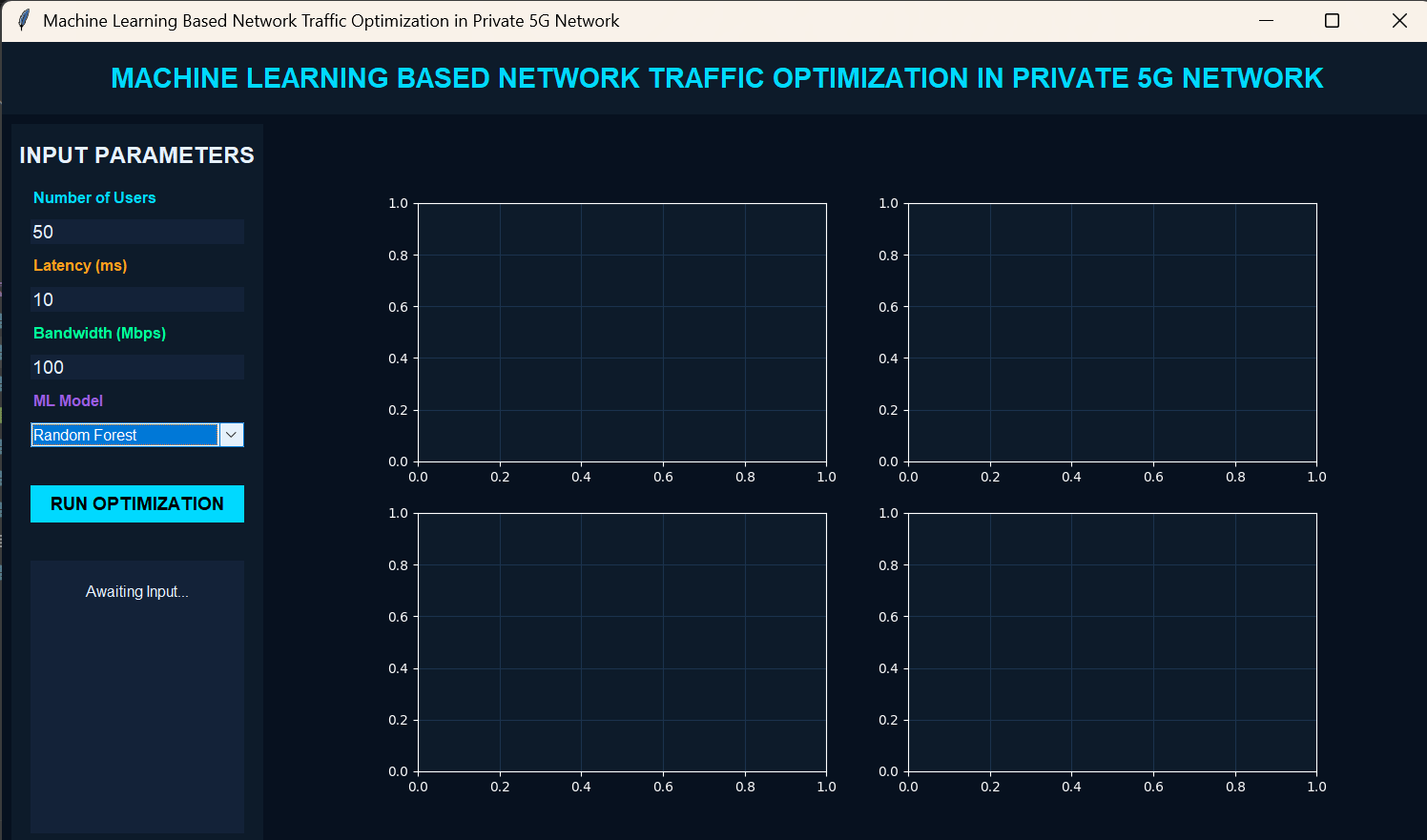
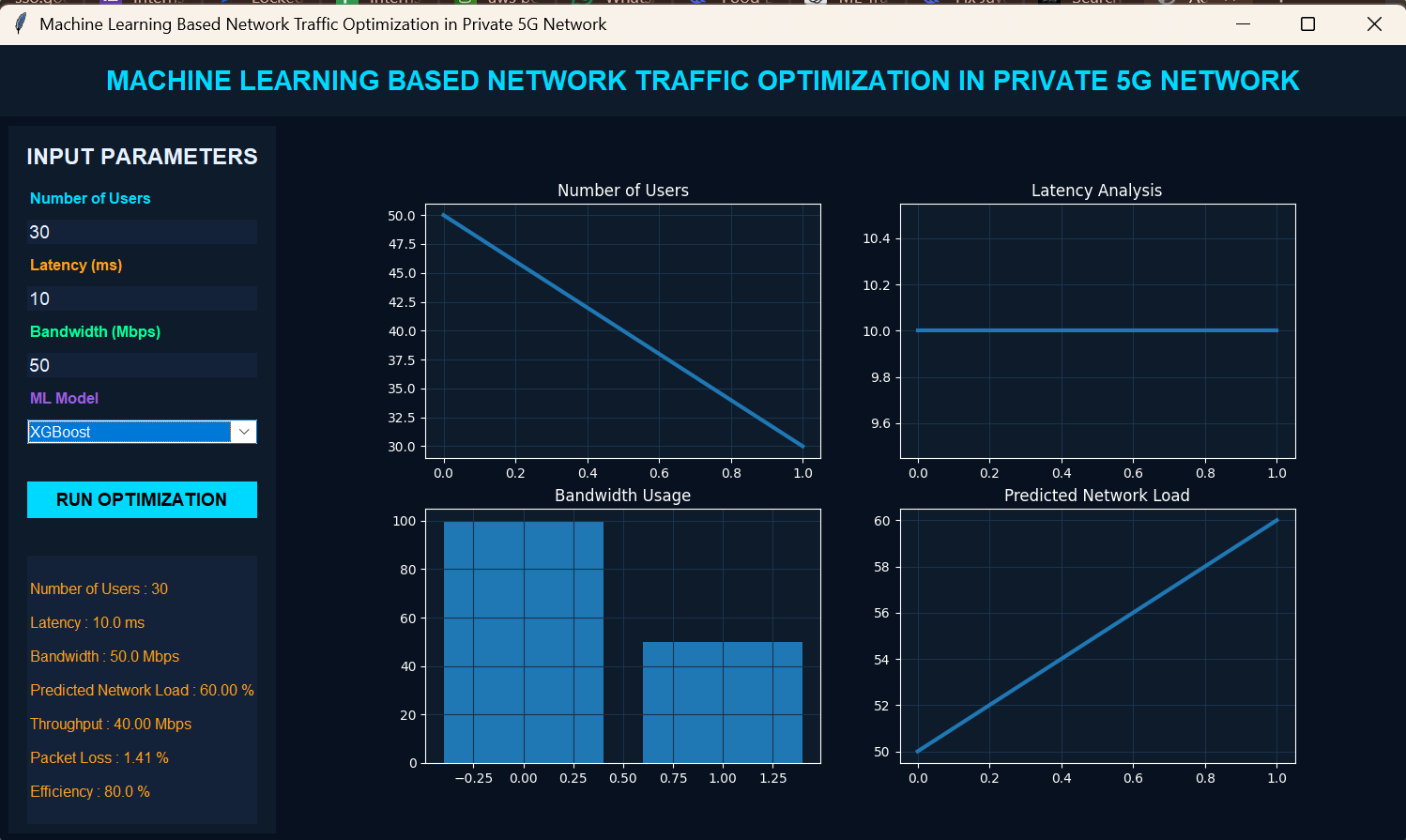
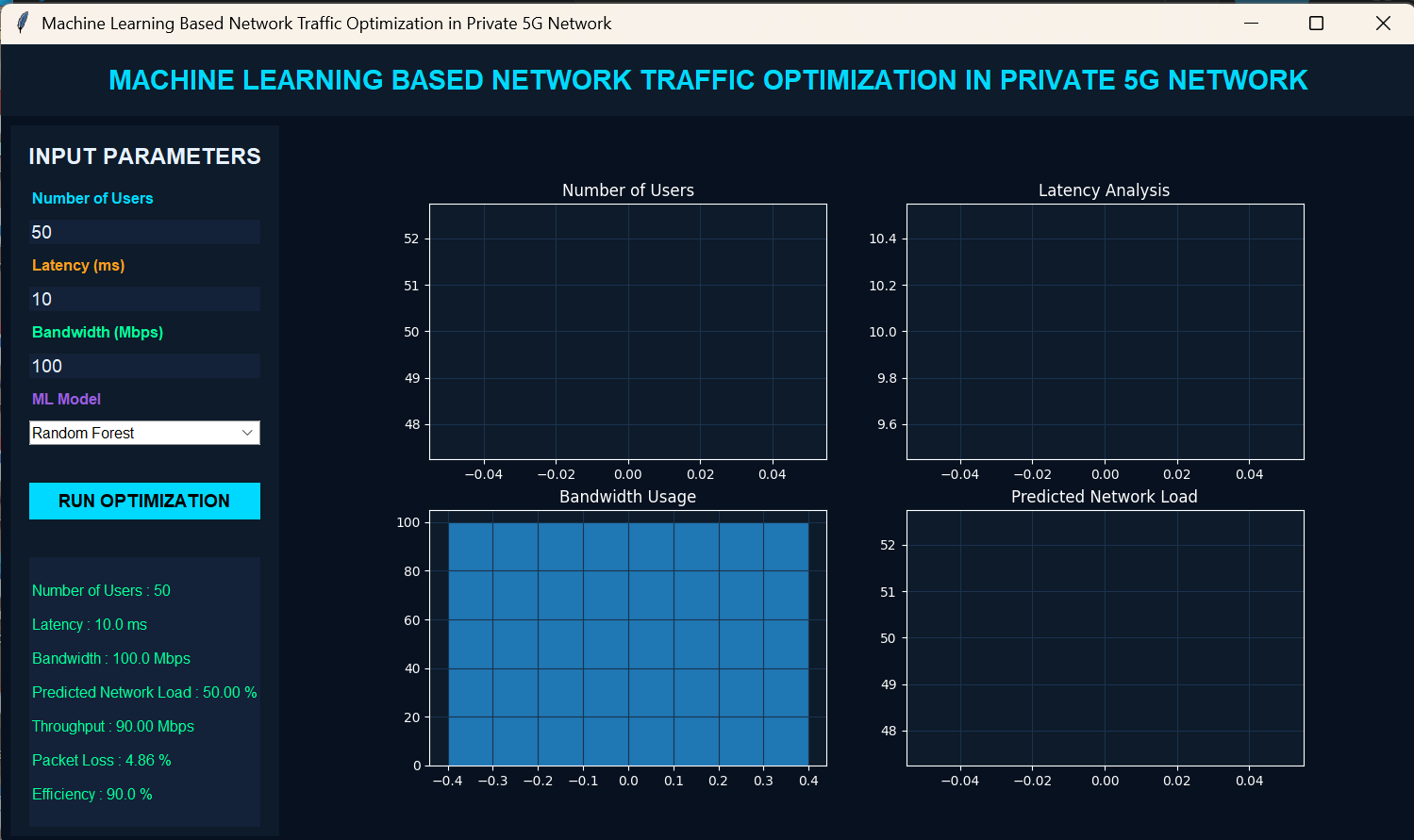
Tkinter was used to develop the graphical user interface. It provides an interactive dashboard where users can enter inputs, monitor traffic conditions, and visualize bandwidth allocation.
Matplotlib was integrated into the project to generate real-time traffic graphs and visualize traffic behavior dynamically.
Pillow (PIL) was used for adding background images and improving the visual appearance of the dashboard.
How the System Works
The system follows a simple and intelligent workflow.
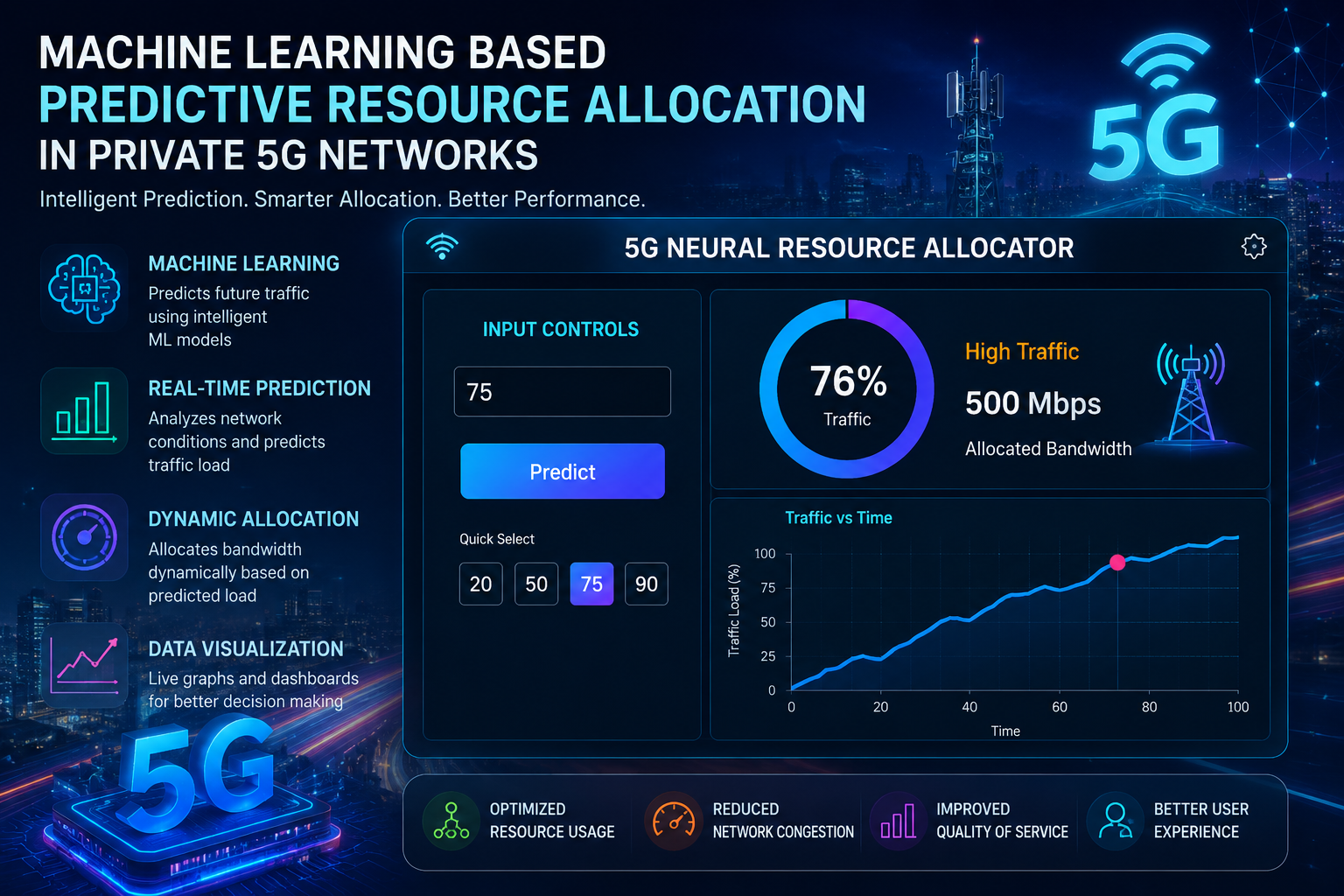
First, the user provides a traffic-related input such as a time slot or traffic intensity level. For example, if the user enters a time slot value of 90, the system interprets it as a peak traffic condition.
The prediction module then analyzes the input and estimates the expected traffic load using machine learning-based logic. Higher time slots result in higher predicted traffic loads.
Once the traffic load is predicted, the system dynamically allocates network resources and bandwidth based on the traffic condition. If the traffic load is minimal, the system allocates lower bandwidth to save resources. If the traffic load is high or peak, the system increases bandwidth allocation to maintain network performance and avoid congestion.
The dashboard then displays the predicted traffic percentage, allocated bandwidth, traffic graph, and network status in real time. This creates a simulation of an intelligent 5G network optimization system.
Advanced Features Used in the Project
One of the key features of the project is predictive resource allocation. Instead of using static allocation methods, the system predicts future traffic conditions and allocates resources dynamically.
A traffic visualization graph was integrated using Matplotlib to display traffic load versus time slot. This helps users understand traffic behavior more clearly.
A custom circular gauge meter was developed to display live traffic load percentages in a visually appealing way.
The project also includes a modern dashboard interface with a background image, dark-themed design, dynamic colors, and interactive controls to improve the overall user experience.
The system intelligently categorizes traffic into multiple levels such as Minimal, Low, Medium, High, and Ultra High. Based on these categories, the system automatically allocates suitable bandwidth levels.
The project simulates how AI-driven systems can optimize private 5G networks by learning traffic patterns and improving network efficiency.
Importance of the Project
Private 5G networks are becoming increasingly important in smart industries, healthcare systems, IoT environments, industrial automation, and autonomous systems. Efficient resource allocation is critical for maintaining low latency, high speed, stable connectivity, and better user experience.
This project demonstrates how machine learning can be applied to solve real-world network optimization problems and improve communication system performance.
Key Learning Outcomes
Through this project, I gained practical knowledge in machine learning integration, GUI application development, traffic prediction, data visualization, resource optimization techniques, and real-time system simulation.
The project also helped improve my understanding of how AI concepts can be integrated into next-generation communication networks.
Future Enhancements
The system can be further enhanced by integrating real-time network traffic data, deep learning models such as LSTM, cloud deployment, multi-cell 5G simulation, and web-based dashboards.
Future versions can also support IoT devices and real-time monitoring for industrial applications.
Conclusion
This project successfully demonstrates how machine learning and predictive analytics can improve resource allocation in private 5G networks. By combining intelligent prediction, dynamic bandwidth allocation, real-time visualization, and interactive dashboards, the system provides an efficient and modern approach to network traffic optimization.
The project highlights the practical implementation of AI concepts in next-generation communication systems and shows how intelligent technologies can enhance future network infrastructure.
RESULTS