Module 1 – Dielectric and Magnetic Materials
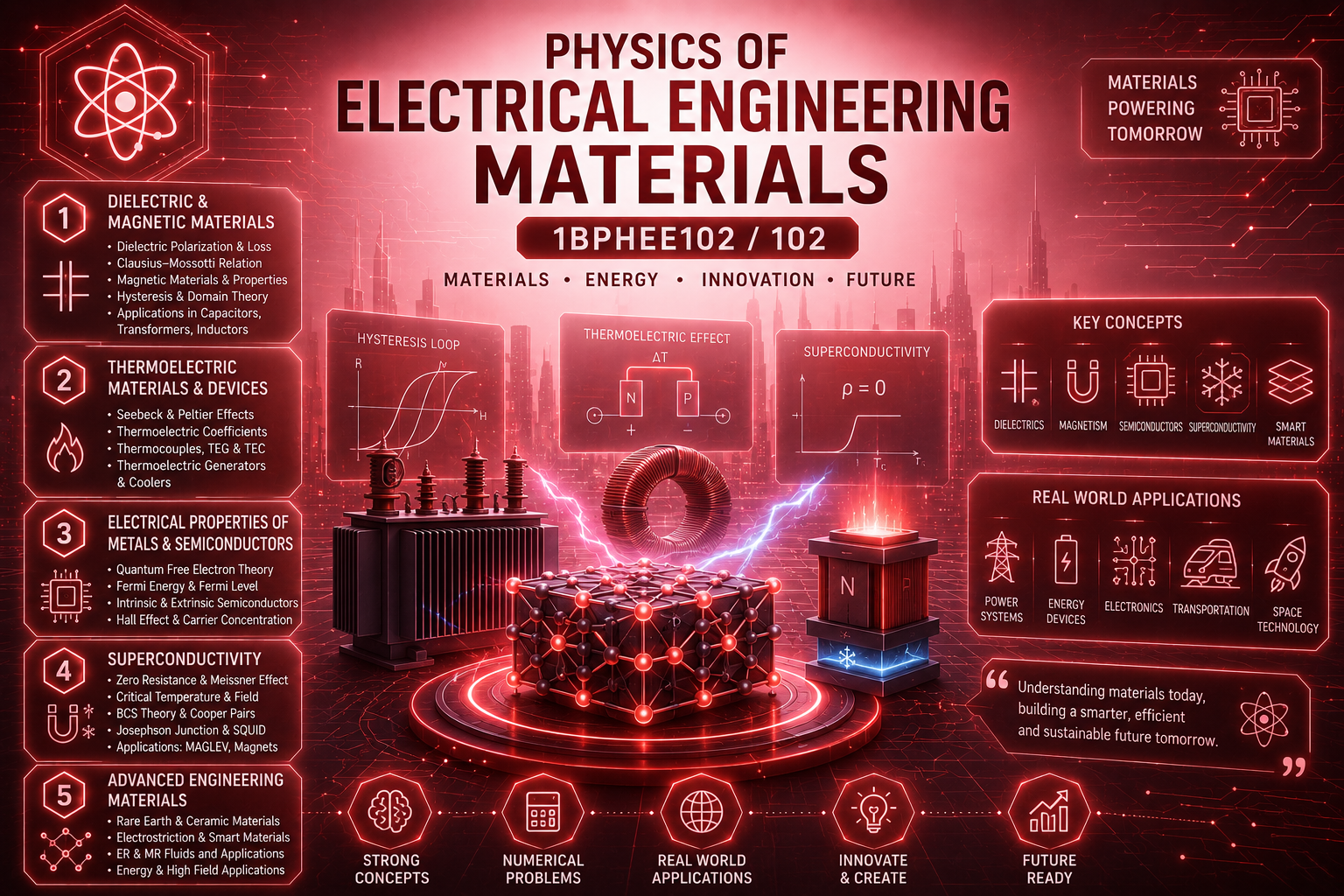
This module explains the electrical and magnetic properties of materials used in electrical and electronic devices. Students learn about dielectric polarization, dielectric loss, and the applications of dielectric materials in capacitors and transformers. Different types of magnetic materials such as ferromagnetic, paramagnetic, and diamagnetic materials are introduced. Concepts like hysteresis, Curie temperature, and domain theory are also discussed. Hard and soft magnetic materials and their engineering applications are explained clearly. Overall, this module helps students understand materials used in transformers, inductors, motors, and high-voltage systems.
Click to get the Module1
Module 2 – Thermoelectric Materials and Devices
This module focuses on thermoelectric effects and energy conversion technologies. Students learn about Seebeck effect, Peltier effect, and thermoelectric coefficients. Devices such as thermocouples, thermopiles, thermoelectric generators, and thermoelectric coolers are explained with working principles. Different thermoelectric materials used in low, medium, and high-temperature applications are also discussed. Practical applications such as automobile exhaust energy recovery, refrigerators, and space power systems are highlighted. Overall, this module introduces eco-friendly energy conversion and cooling technologies.
Click to get the Module2
Module 3 – Electrical Properties of Metals and Semiconductors
This module explains the behavior of electrons in metals and semiconductors. Students learn the limitations of classical electron theory and the basics of quantum free electron theory. Important concepts like density of states, Fermi energy, and Fermi-Dirac statistics are introduced. The module also covers intrinsic and extrinsic semiconductors along with carrier concentration and Fermi level concepts. Hall effect and electron scattering mechanisms are explained with numerical problems. Overall, this module provides the foundation for understanding semiconductor devices and electronic materials.
Click to get the Module3
Module 4 – Superconductivity
This module introduces superconductivity and its unique properties like zero electrical resistance and persistent current. Concepts such as Meissner effect, critical temperature, critical field, and Cooper pair formation are explained. Students learn about BCS theory and the difference between Type-I and Type-II superconductors. High-temperature superconductors and vortex formation are also discussed. Applications such as superconducting magnets, MAGLEV trains, Josephson junctions, and SQUID devices are highlighted. Overall, this module explains advanced materials used in high-speed and energy-efficient technologies.
Click to get the Module4
Module 5 – Electrical Engineering Materials
This module focuses on advanced electrical engineering materials and their smart applications. Rare earth materials and their role in modern energy systems are discussed. Students learn about ceramics, electrostrictive materials, electrorheological fluids, and magnetorheological materials. The module explains how electric and magnetic fields can change the properties of these materials. Applications in sensors, actuators, dampers, and smart devices are also covered. Numerical problems related to engineering materials are included for better understanding. Overall, this module introduces smart and functional materials used in modern electrical engineering technologies.