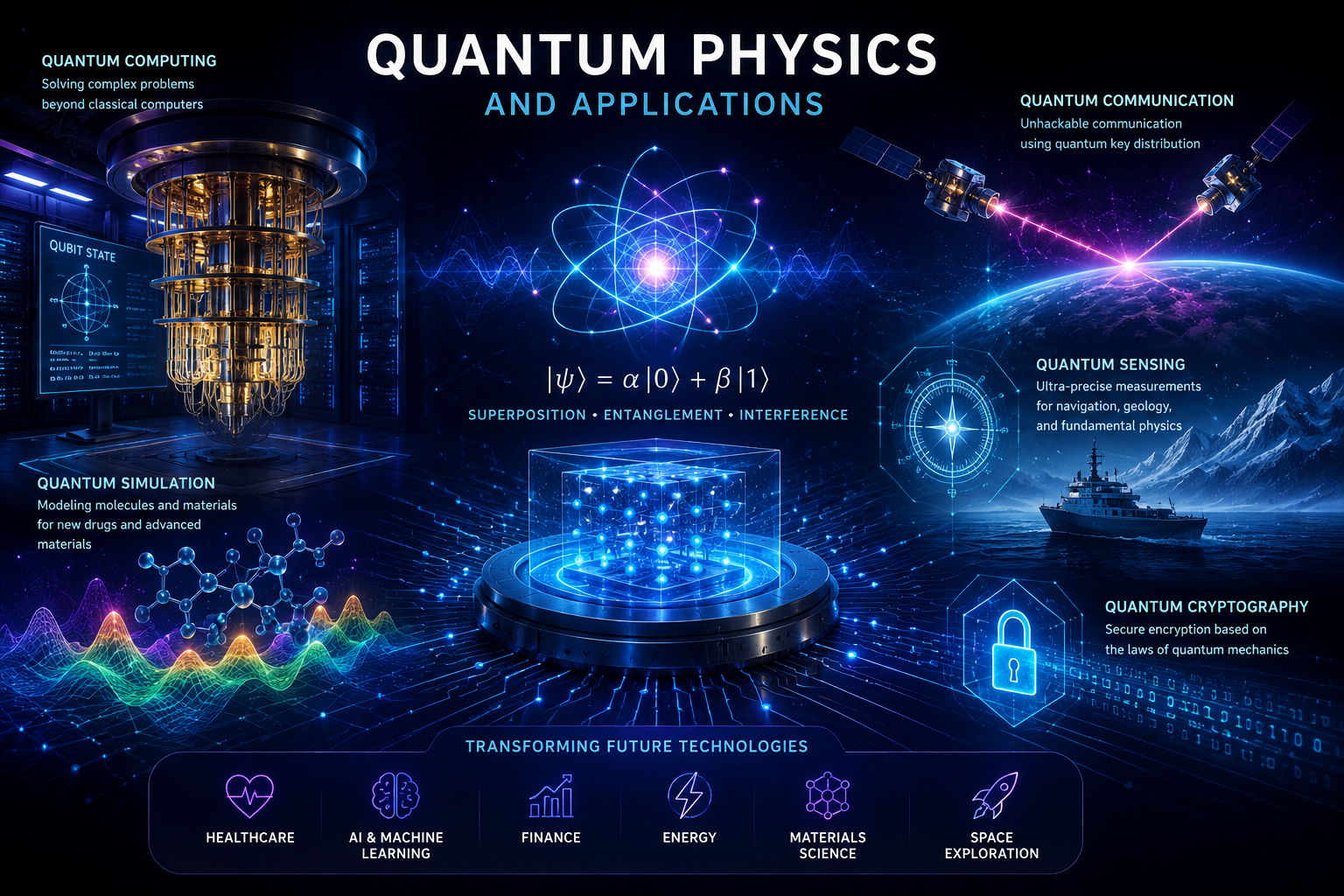
Module 1 – Quantum Mechanics
This module introduces the fascinating world of microscopic particles such as electrons and atoms, where classical physics no longer works properly. It begins with de Broglie’s idea that particles can behave like waves and then explains Heisenberg’s uncertainty principle, which says we cannot know both the exact position and momentum of a particle simultaneously. The Schrödinger wave equation is studied as the fundamental equation of quantum mechanics, helping us understand how particles behave probabilistically. Concepts like wave function, probability density, eigen values, and expectation values explain how measurements are interpreted in quantum terms. The particle in a one-dimensional potential well shows how energy becomes quantized at microscopic scales. The module also discusses tunneling, where particles can pass through barriers even without sufficient classical energy. Overall, this module builds the foundation for modern physics, nanotechnology, and quantum devices.
Click to get the Module1
Module 2 – Electrical Properties of Metals and Semiconductors
This module explains how electricity flows in metals and semiconductors using quantum theory. It first discusses why the classical free electron theory failed to explain many electrical properties of metals. Then, quantum free electron theory and Fermi-Dirac statistics are introduced to describe electron behavior more accurately. Important concepts like density of states, Fermi energy, and electrical conductivity help in understanding how electrons occupy energy levels. The module also explains intrinsic and extrinsic semiconductors, which form the backbone of modern electronic devices like diodes and transistors. Hall effect is studied to determine the type and concentration of charge carriers in materials. Numerical problems help apply these concepts practically. This module forms the basic physics behind electronic engineering and semiconductor technology.
click to get the Module2
Module 3 – Superconductivity
This module deals with superconductivity, a remarkable phenomenon where certain materials show zero electrical resistance at very low temperatures. It explains concepts such as persistent current, Meissner effect, critical temperature, critical current, and critical magnetic field. The formation of Cooper pairs through electron-phonon interaction is introduced as the basis of superconductivity. BCS theory explains how electrons pair up and move without energy loss inside a superconductor. Differences between Type-I and Type-II superconductors and the formation of vortices are also discussed. Devices like Josephson junctions and SQUIDs show practical applications of superconductivity in highly sensitive magnetic measurements and quantum technologies. This module connects fundamental physics with advanced technological applications like MRI machines, quantum computers, and magnetic levitation.
Click to get the Module3
Module 4 – Photonics
Photonics focuses on the generation, manipulation, and detection of light. The module begins with the interaction of radiation with matter and Einstein’s A and B coefficients, which form the theoretical basis for lasers. Different types of lasers, especially semiconductor diode lasers, are studied along with the conditions necessary for lasing action. Optical modulators based on Pockels and Kerr effects explain how light signals can be controlled. Photodetectors such as Single Photon Avalanche Diodes and superconducting nanowire detectors are introduced for sensitive light detection. Optical fibers, numerical aperture, V-number, and losses explain how light travels through communication networks. The Mach-Zehnder interferometer demonstrates interference-based optical applications. This module is highly relevant in fiber-optic communication, modern networking, and optical sensing technologies.
Click to get the Module4
Module 5 – Quantum Computing
This module introduces the basics of quantum computing, one of the most advanced fields in modern science and technology. It starts with the limitations of classical computing and Moore’s law, leading to the need for quantum computation. The concept of a qubit is explained as the quantum version of a classical bit, capable of existing in multiple states simultaneously. Bloch sphere and Dirac notation help visualize and mathematically represent quantum states. Different types of qubits, especially superconducting qubits, are discussed along with the importance of anharmonicity. Quantum gates such as Pauli gates, Hadamard gate, phase gates, and CNOT gate are introduced as building blocks of quantum circuits. Entanglement and Bell states show how quantum systems can exhibit powerful correlations impossible in classical systems. This module provides a foundation for understanding future quantum technologies and quantum computers.